
Top 10 residential ESS cell brands in Southeast Asia are the cell sources most visible in battery-manufacturer procurement across Vietnam, Thailand, the Philippines, Malaysia and Indonesia during H1 2026. When a manufacturer quotes a 10 kWh or 15 kWh home battery, the cell brand inside the pack affects cost, cycle-life data, supply continuity and the documents behind the finished product.
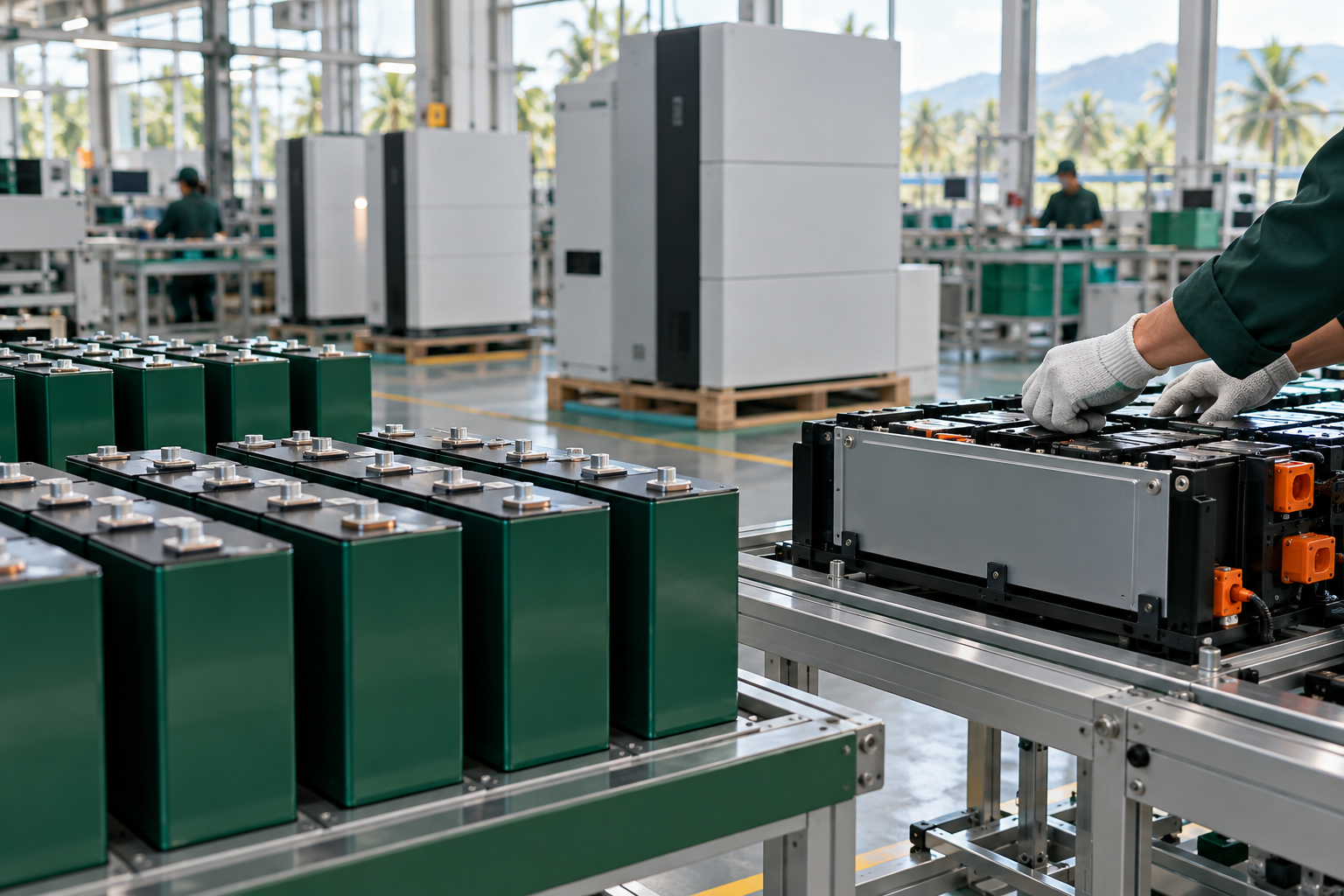
Top 10 residential ESS cell brands in Southeast Asia
| Rank | Cell brand | Country or region | Regional residential ESS position | Supply profile |
|---|---|---|---|---|
| 1 | EVE Energy | China | Highest regional shipment position | Large-format and cylindrical LFP options, strong manufacturing scale and Southeast Asian channel reach |
| 2 | Great Power | China | Second position | 50Ah to 280Ah cell range, cost-focused supply and established residential ESS channels |
| 3 | REPT BATTERO | China | Fast-growing high-volume supplier | Wound LFP cells, long-cycle positioning and supply links with major ESS brands |
| 4 | CATL | China | Large-scale cell supplier | Large prismatic LFP cells and direct supply to large customers and regional channels |
| 5 | BYD Energy Storage | China | Vertically integrated battery group | Cell, pack and system capability with stable use in Vietnam and the Philippines |
| 6 | CALB | China | Fast-growing regional supplier | Cost-effective prismatic LFP cells for mid-sized and large residential battery packs |
| 7 | Cornex Energy | China | Newer brand with rapid growth | 100Ah to 200Ah cell range and growing supply to local integrators and smaller pack makers |
| 8 | LG Energy Solution | South Korea | Premium residential cell supplier | NCM and LFP routes for Korean system companies and higher-end residential projects |
| 9 | Gotion High-Tech | China | Broad regional residential presence | Cylindrical and prismatic cells, local assembly support and Southeast Asian service routes |
| 10 | Samsung SDI | South Korea | Premium, lower-volume supplier | Higher-end residential and international projects, especially through established Korean channels |
For a China-only comparison, see 2026 H1 Top 10 Chinese Residential Energy Storage Cell Brands by Shipments. That list follows Chinese-brand shipment scale; this article follows cell use and supply visibility among Southeast Asian residential battery manufacturers.
Data sources and ranking rules
The main measure is H1 2026 residential ESS cell shipment capacity across Vietnam, Thailand, the Philippines, Malaysia and Indonesia. The regional calculation weights Vietnam at 40%, Thailand at 25%, the Philippines at 20%, and Malaysia plus Indonesia at 15%.
The research combines regional shipment tracking from InfoLink Consulting, SNE Research and Frost & Sullivan with company reports, export records, local battery-factory procurement sampling, residential ESS exhibition evidence and channel cross-checks involving Deye, Growatt and local distributors. The ranking uses the midpoint of the cross-checked range for each brand.
Small local transactions and grey-market trans-shipments are excluded. The scope stays within residential ESS rather than commercial, grid-scale or EV batteries. The result is a practical regional shortlist for distributors and battery factories, not a global cell-manufacturer table.
Cell brands and battery brands are different businesses
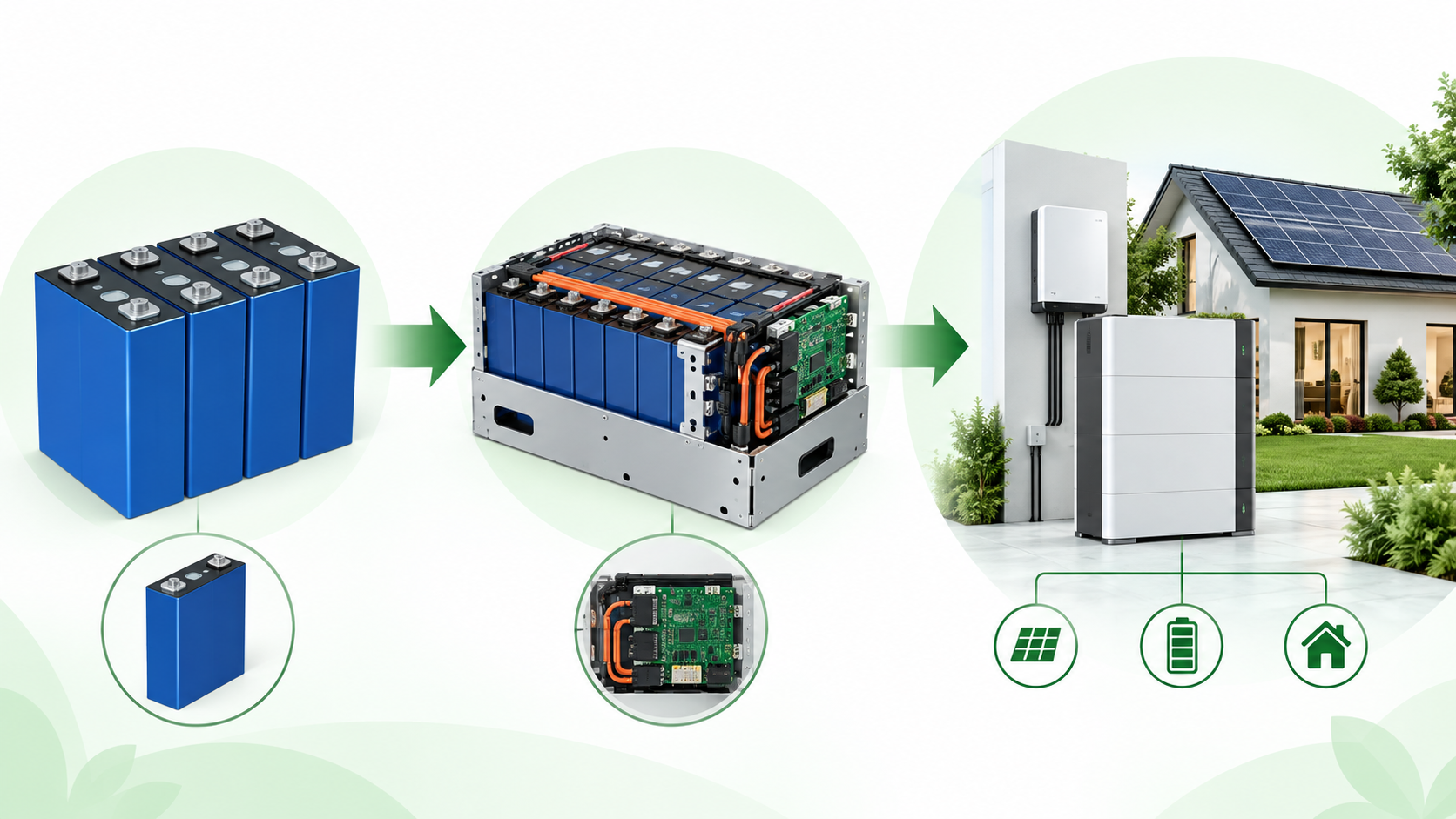
A cell brand makes the electrochemical unit. A battery manufacturer selects cells, builds modules, installs the BMS, completes the enclosure and sells the finished battery. An ESS brand then combines the battery with an inverter, EMS, monitoring platform and installation service.
| Supply layer | What it determines | What the buyer should identify |
|---|---|---|
| Cell brand | Cell cost, capacity, consistency and upstream traceability | Exact model, chemistry, format, batch and production route |
| Battery factory | Pack design, BMS settings, protection, certification and warranty responsibility | Finished battery model, BOM, BMS communication and warranty issuer |
| System brand | Inverter compatibility, commissioning, monitoring and local service | Complete system topology, inverter model and market support |
This is why a finished 51.2 V home battery cannot be compared with a cell price by dividing pack capacity by the cell quotation. The cell, the pack and the complete ESS carry different engineering work and warranty responsibilities.
The top 10 cell brands in detail
1. EVE Energy
EVE Energy leads this Southeast Asian residential ESS cell ranking. The company supplies cylindrical and prismatic LFP cells, giving battery manufacturers room to build compact residential packs as well as larger-format 48 V and high-voltage systems.
Its large energy-storage manufacturing platform supports high-volume orders, with visible supply routes in Vietnam, Thailand and the Philippines. EVE cells are also used by small and mid-sized battery pack manufacturers that need a recognised cell source for high-temperature residential markets.
EVE is strongest when the project needs repeatable volume, a broad cell portfolio and a supply route that supports tropical residential ESS production. The quotation should name the exact cell model, format, production site and test document because cylindrical and prismatic products serve different pack designs.
2. Great Power
Great Power ranks second. Its residential ESS cell portfolio covers approximately 50Ah to 280Ah formats, giving regional battery manufacturers a practical range for small home batteries, modular 48 V systems and larger residential packs.
The company has a strong cost-performance position and deep channel connections across Southeast Asia. Its cells are associated with residential ESS supply routes involving Deye, Growatt and local battery manufacturers, so the brand appears in both finished-system procurement and cell-level sourcing discussions.
Great Power suits projects that need a commercially competitive cell and a factory with experience beyond standalone cell production. CVC can connect the target battery model, cell specification and pack-factory route into one quotation instead of treating the cell as an isolated line item.
3. REPT BATTERO
REPT BATTERO takes third place and has one of the fastest-growing positions in the regional residential ESS supply chain. Its wound LFP cell platform is associated with long-cycle residential storage and large-volume energy-storage production.
The company has supply links with Huawei and Deye-related residential ESS channels in Southeast Asia. That gives REPT BATTERO strong visibility among battery manufacturers that want a cell source familiar with household storage pack integration and tropical operating conditions.
REPT BATTERO is a strong candidate for high-volume LFP cells, a long-cycle product direction and a clear production route. CVC can match the selected REPT cell with the battery factory, BMS configuration and target inverter platform.
4. CATL
CATL ranks fourth in Southeast Asian residential ESS cell use. Its strength is large-scale prismatic LFP production and a supply network serving major battery and energy-storage customers.
CATL is relevant to manufacturers that want a high-volume cell source for larger residential packs, modular home storage and projects connected to established solar channels. The brand also benefits from strong recognition among distributors and system integrators.
Separate three products in the quotation: a CATL-origin cell, a battery pack assembled with CATL cells and a CATL-approved complete system. CVC identifies the product level and connects buyers with the factory route that matches the cell and finished-battery specification.
5. BYD Energy Storage
BYD Energy Storage ranks fifth. Its vertically integrated structure connects battery cells, packs and complete energy-storage products, giving the brand a strong position in Southeast Asian residential projects.
BYD has stable residential storage visibility in Vietnam and the Philippines. Its battery manufacturing experience and system capability also make it familiar to customers who want one recognised brand across the battery and wider energy-storage chain.
BYD fits buyers who value vertical integration and a defined system channel. The supply discussion should identify whether the requirement is a BYD finished battery, a BYD cell for a third-party pack, or a complete integrated system. CVC sources the appropriate route and keeps the quotation focused on the product the buyer needs.
6. CALB
CALB ranks sixth and is gaining residential ESS volume in Southeast Asia. Its prismatic LFP cells give regional pack manufacturers a cost-focused option for mid-sized home batteries and larger modular systems.
The company is particularly relevant to battery manufacturers in Vietnam and Thailand that need a scalable cell source for local assembly. CALB’s position also reflects the move toward large-format LFP cells, where battery factories want more energy per module and fewer parallel cell strings.
CALB works well for buyers comparing price, format and supply continuity across Chinese cell brands. CVC can connect the target capacity and pack design with the appropriate CALB supply route, production batch and battery-factory integration plan.
7. Cornex Energy
Cornex Energy ranks seventh. It is a newer cell brand in this list, with fast growth in Southeast Asian residential ESS procurement and an energy-storage range around 100Ah to 200Ah.
The brand is increasingly visible among local integrators and smaller battery manufacturers in Vietnam and Indonesia. That makes Cornex relevant to buyers who want a flexible regional supply route rather than a cell brand used only by the largest system companies.
Cornex is a useful option for small and mid-sized residential battery programs. The exact cell model, mass-production status, cycle test, warranty route and factory of origin belong in the quotation package. CVC connects Cornex supply with the target pack factory and keeps the cell, BMS and inverter specification aligned.
8. LG Energy Solution
LG Energy Solution ranks eighth and holds a premium position in Southeast Asian residential storage. Its supply route includes NCM and LFP technologies, serving Korean system companies and higher-end residential projects in Vietnam and Thailand.
The brand is valuable where energy density, established international supply channels and premium system positioning are central to the product offer. Korean-linked battery and solar companies also give LG Energy Solution a ready route into selected residential markets.
LG Energy Solution is best evaluated at product-model level because chemistry, pack architecture and warranty route change the commercial result. CVC helps buyers source the correct battery or cell route while keeping the finished product, target market and service responsibility clear.
9. Gotion High-Tech
Gotion High-Tech ranks ninth. Its portfolio includes cylindrical and prismatic cells, allowing Southeast Asian battery manufacturers to compare different pack architectures under one recognised cell brand.
Gotion has a visible presence in the Philippines and Indonesia, supported by local assembly suppliers and service-oriented channel relationships. That regional connection matters for battery factories that need technical communication, batch records and a practical route for replacement or warranty support.
Gotion suits residential ESS programs that combine local pack assembly with a recognised international cell source. CVC can connect the required Gotion model with a suitable pack manufacturer, export route and system-level product offer.
10. Samsung SDI
Samsung SDI takes tenth place. Its Southeast Asian residential ESS position is smaller than the leading Chinese cell brands, but its premium reputation keeps it visible in high-end projects and Samsung-linked channels in Singapore and Thailand.
The brand suits projects where premium positioning, international channel confidence and a Korean technology ecosystem carry more weight than the lowest cell cost. Its lower-volume profile also makes the supply route and target product model important for a distributor planning repeat orders.
Samsung SDI is a premium cell option for selected residential and international projects. CVC can connect the project with an available manufacturer, product model and commercial supply route rather than treating brand recognition as a substitute for an actual quotation.
How to use this ranking in a procurement decision
Use the list to build a supplier shortlist, then move from brand name to the actual cell and pack documents. A useful procurement file contains:
- Exact cell model, chemistry, format and nominal capacity.
- Production site, supplier entity and batch traceability.
- Charge and discharge limits, operating temperature and cycle-test conditions.
- The battery factory using the cells and the finished battery model.
- BMS communication, inverter compatibility and target-market certificates.
- MOQ, lead time, warranty issuer and replacement route.
The cell label should appear consistently across the cell sample, incoming inspection record, pack BOM, battery label and warranty file. This document chain prevents a common sourcing problem: a recognised cell brand is mentioned during the quotation, while the finished battery uses a different model or supply route.
For product-level reference, visit CVC’s Energy Storage Batteries category and energy storage product downloads. Buyers planning private-label or local battery assembly can also review CVC’s energy storage OEM/ODM support.
How CVC supports cell and battery sourcing
CVC connects distributors, installers and battery manufacturers with suitable cell and finished-battery supply routes. The work covers product matching, factory communication, specification comparison, sample coordination, quotation support and export arrangements.
For a Southeast Asian residential ESS project, send the target battery capacity, cell format, inverter brand, market, order quantity and delivery requirement. CVC narrows the shortlist to an available cell brand, pack factory and finished product that fit the commercial route.
FAQ
What is the difference between a cell brand and a battery brand?
A cell brand supplies the electrochemical cells. A battery brand builds the cells into a pack with a BMS, enclosure, protection system and warranty. A system brand then combines the battery with an inverter, EMS and installation service.
Does a top-ranked cell brand fit every residential battery project?
The ranking identifies strong regional suppliers. The finished product needs the correct cell format, capacity, current rating, temperature range, BMS settings and certification package. CVC handles this matching step with the battery factory and project requirements.
How can a buyer verify the cell brand inside a finished battery?
Ask for the cell model, batch code, BOM, incoming inspection record and sample photographs. Match those records with the battery label, BMS configuration and warranty file. A cell name on a sales sheet alone does not establish the cell used in the finished pack.
Which cell formats appear most often in Southeast Asian residential ESS?
Large prismatic LFP cells are common in modular 48 V and high-voltage home batteries. Cylindrical cells remain relevant in selected compact and cost-focused designs. The correct format follows the pack architecture, inverter voltage and target price position.
Conclusion
EVE Energy, Great Power, REPT BATTERO, CATL and BYD lead the H1 2026 regional shortlist, while CALB, Cornex, LG Energy Solution, Gotion and Samsung SDI serve important mid-market or premium supply routes.
The ranking gives buyers a clear place to start. The purchasing decision comes from the cell model, the battery factory, the traceability file and the supply route behind the finished product. CVC helps buyers turn that shortlist into a real cell or residential battery quotation.

Peter Yin
Request residential ESS cell sourcing support
Send your target capacity, cell format, market and quantity. CVC will connect the project with suitable cell and battery suppliers.