
Short answer: classify the project before choosing the battery
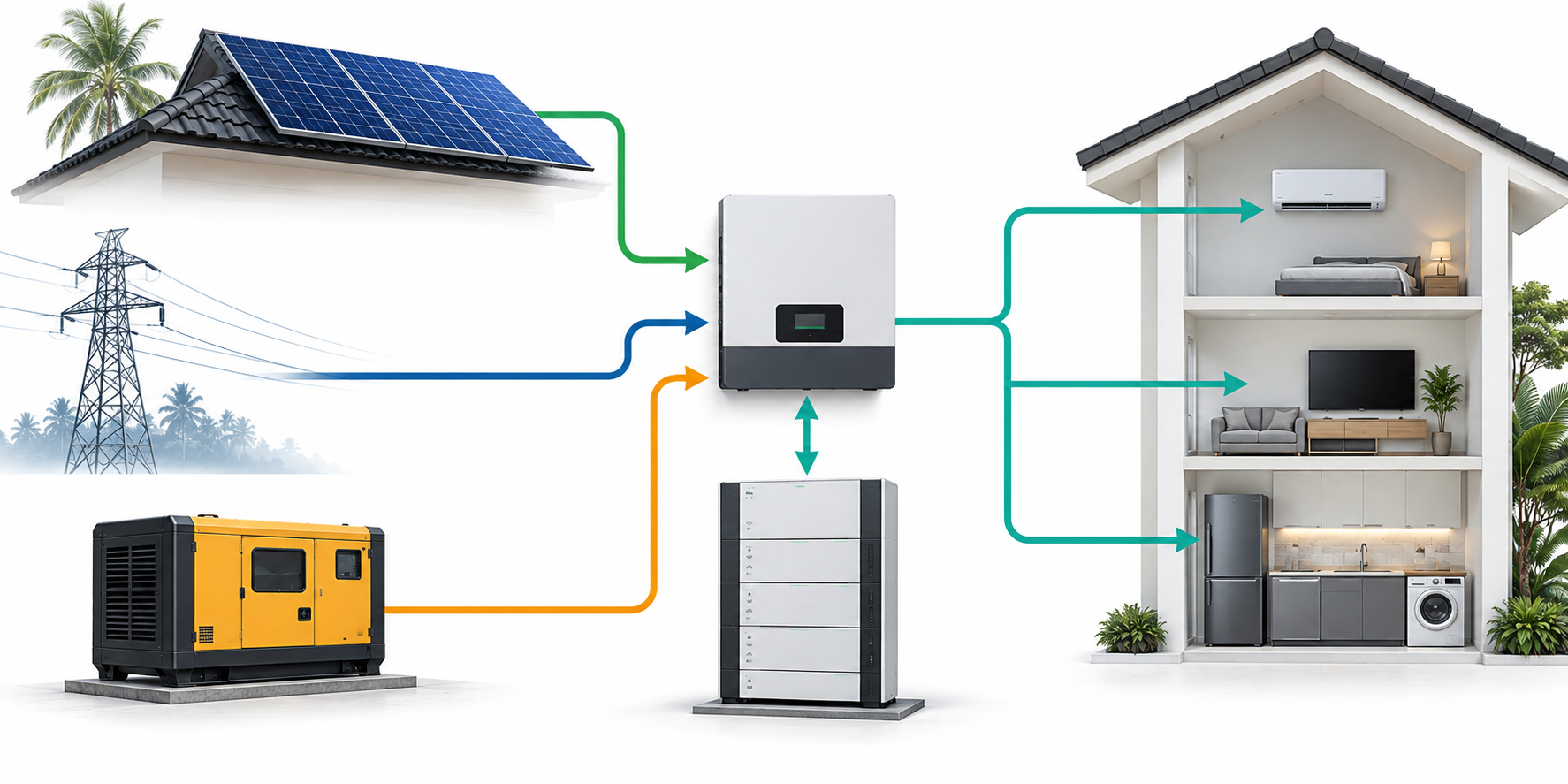
The right battery quote for an Indonesian home starts with the load profile, not a nominal capacity. Start with the operating route: PLN-connected solar storage, grid-connected backup, or an off-grid and genset hybrid system.
Then calculate the critical load, backup hours, inverter output, battery current and communication method. The result is a quote-ready specification instead of a battery price based on kWh alone. For the wider Southeast Asia energy storage market, the same project-first method keeps product selection tied to the local load and power source.
What Indonesia’s energy data means for battery buyers
Indonesia is a national market with materially different power conditions. The 2024 electricity statistics report a national electrification ratio of 99.83%, while reported ratios are lower in some provinces, including 96.35% in Nusa Tenggara Timur, 94.49% in Papua Tengah and 94.02% in Papua Pegunungan. A PLN-connected home therefore needs a different product route from a remote island site using local generation.
The official PLN RUPTL 2025–2034 plans 69.5GW of additional generation and storage capacity, including 17.1GW of solar capacity and 10.3GW of storage. This supports long-term solar-plus-storage development, but the battery size for an individual home still comes from its load profile.
Permen ESDM No. 2/2024 places rooftop-solar decisions within PLN-area quotas and removes the previous export-import energy credit mechanism. For a home-storage project, calculate how much PV energy will be used on site and how much backup power the household actually needs.
Sources: Indonesia Electricity Statistics 2024, PLN RUPTL 2025–2034 and Permen ESDM No. 2/2024 summary.
Match the battery to the critical load
The basic calculation is:
Nominal battery capacity = critical load × backup hours ÷ inverter efficiency ÷ usable DoD
The calculation gives the energy requirement. The inverter and battery must also support the load’s continuous and starting power.
Example 1: essential home backup
| Load | Working assumption |
|---|---|
| Refrigerator | 120W average |
| LED lighting | 150W |
| Router and ONT | 15W |
| Fans | 75W |
| Security equipment | 40W |
| Total | 440W |
For eight hours of backup: 0.44kW × 8h ÷ 0.92 ÷ 0.90 ≈ 4.25kWh. A 5kWh-class battery is the first capacity range to evaluate. The quotation must include the refrigerator’s compressor start-up power and the inverter’s surge rating.
Example 2: home or small shop with refrigeration and a pump
For an average critical load of 1.45kW for six hours: 1.45kW × 6h ÷ 0.92 ÷ 0.90 ≈ 10.5kWh. This load sits close to the boundary of a 10kWh battery. Check the pump and refrigeration start-up current when selecting the inverter. If an air conditioner is added, put its running power and compressor start into the load sheet.
Example 3: remote or genset-hybrid site
An average load of 2kW for 12 hours requires 24kWh on the load side before conversion losses and reserve settings. The project needs a larger battery bank, enough PV to recharge it, and a generator control plan for long cloudy periods or extended high loads. For the operating relationship between solar, battery and diesel generation, see CVC’s Indonesia solar-plus-battery and genset guide.
Choose the product route by system architecture
51.2V low-voltage battery systems
CVC’s Firefly Low Voltage platform covers 3.6kWh, 7.2kWh, 10.8kWh and 14.4kWh nominal configurations, with usable capacities of 3.24kWh, 6.48kWh, 9.72kWh and 12.96kWh. It uses a 51.2Vdc architecture and supports CAN, RS485 and Wi-Fi communication, with up to 43.2kWh through parallel configuration.
16kWh-class low-voltage batteries
| Product | Key data for first-round selection |
|---|---|
| Firefly Max-16K | 16.179kWh nominal, 14.561kWh usable, 51.2V, rated discharge up to 10.24kW, IP65 |
| M16S314BL-YV | 16.076kWh, 51.2V, 314Ah, maximum charge/discharge current 200A, RS485/CAN/RS232 |
These batteries suit larger homes, small shops and longer backup requirements. The inverter still determines the usable AC output, and the battery current must support the requested discharge power.
Integrated all-in-one systems
Firefly OS-RESS combines a high-voltage LiFePO4 battery, hybrid inverter, BMS and EMS in one platform. The battery configurations are 10kWh and 15kWh, with 9.4kWh and 14.25kWh available capacity. It supports CAN, RS485, Wi-Fi and Ethernet communication and uses an IP65 enclosure.
Three-phase hybrid inverter projects
CVC’s three-phase residential hybrid inverter range covers 6–15kVA, supports generator access and uses a 125–600V battery voltage range with a maximum battery charge/discharge current of 50A. This is a different architecture from a 51.2V low-voltage battery. Pair the inverter with a battery whose voltage range, battery current, BMS communication and phase configuration match the project.
Check these parameters before you quote
Battery and inverter
- Battery nominal voltage and operating voltage range.
- Inverter battery voltage range.
- Continuous charge and discharge current.
- Continuous and peak inverter output.
- Usable capacity and reserve SOC settings.
- CAN or RS485 communication method, pinout, protocol and firmware.
- Parallel quantity and master/slave configuration.
- Operating temperature and enclosure rating.
PLN, PV and genset
- PLN-connected or off-grid operation.
- Single-phase or three-phase supply and rated frequency.
- PV capacity and MPPT range.
- Generator rated kVA, voltage, phase and start signal.
- Critical-load panel and transfer arrangement.
- Local installation and approval requirements.
Build the quote by connecting these parameters in one system file. Use the battery datasheet together with the inverter compatibility record, BMS protocol and project load sheet.
Indonesia battery supplier checklist
| Required project information | What to provide |
|---|---|
| Location | City, island or province |
| Power source | PLN, local grid, PV, genset or hybrid |
| Load list | Appliance, rated power and starting power |
| Backup target | Critical loads and required hours |
| PV system | PV capacity and inverter model |
| Battery target | Capacity, voltage platform and expansion plan |
| Genset data | kVA, voltage, phase and control method |
| Commercial requirement | Sample, quantity, packaging and destination |
| Documents | Datasheet, manual, certificates, BMS protocol and warranty |
How CVC supports an Indonesia project
CVC Energy connects Indonesian distributors, installers and project buyers with suitable battery and inverter supply routes. We can help organize low-voltage, high-voltage and all-in-one comparisons, model matching, BMS communication review, product documents, sample requests, factory coordination, quotations and export support.
Send the project location, critical-load list, backup hours, PV size, existing inverter or genset model and target quantity. The CVC Downloads library collects available product documents for the next matching and quotation step. For direct project coordination, use the CVC contact page.
FAQ
Is a 10kWh battery enough for an Indonesian home?
It can support a defined critical-load circuit. A 1.45kW load running for six hours already requires about 10.5kWh of nominal capacity under the example assumptions above.
How do I match a 51.2V battery with a hybrid inverter?
Match the inverter voltage range, current limit, BMS communication, protocol, port wiring and firmware requirements. A 51.2V label alone does not complete the compatibility check.
Can a battery replace a genset?
A battery can handle daily short-duration backup and reduce generator runtime. A genset remains valuable for long outages, extended cloudy weather and sustained high loads. Design both operating modes when the site needs long-duration reliability.
What should I send before requesting a battery quote?
Send the location, power source, phase, load list, starting loads, backup hours, PV size, existing inverter or genset model, target capacity, quantity and required documents.
Conclusion: quote the operating system, not only the battery
- Identify PLN-connected, hybrid-backup or off-grid operation.
- Separate critical and non-critical loads.
- Calculate usable energy and starting power.
- Match battery voltage, current and BMS communication with the inverter.
- Add PV, PLN and genset information to the same project file.
- Request datasheet, compatibility documents, certificates, warranty and export documents before final quotation.

Peter Yin
Send an Indonesia Project Inquiry
Tell us your location, critical loads, backup hours, PV or genset details and expected quantity.