Which Deye battery architecture should a distributor quote: low voltage or high voltage?
For a 5 kW home backup project, the low-voltage route is usually the clearest starting point when the selected Deye inverter uses a 40–60 V battery input. For an 8–12 kW project, read the inverter’s battery voltage range and current limit first. Deye also has high-power low-voltage models, so inverter power alone does not identify the battery architecture. A three-phase Deye inverter can also use a 48 V battery system.
The rule is direct: once the inverter voltage architecture is selected, the battery must come from the matching voltage family. The current, cable size, BMS rating, module arrangement and communication record all follow from that choice.
Do not quote “a Deye battery” as a generic item. Quote the exact inverter model, battery voltage class, operating voltage range and compatible battery configuration together.
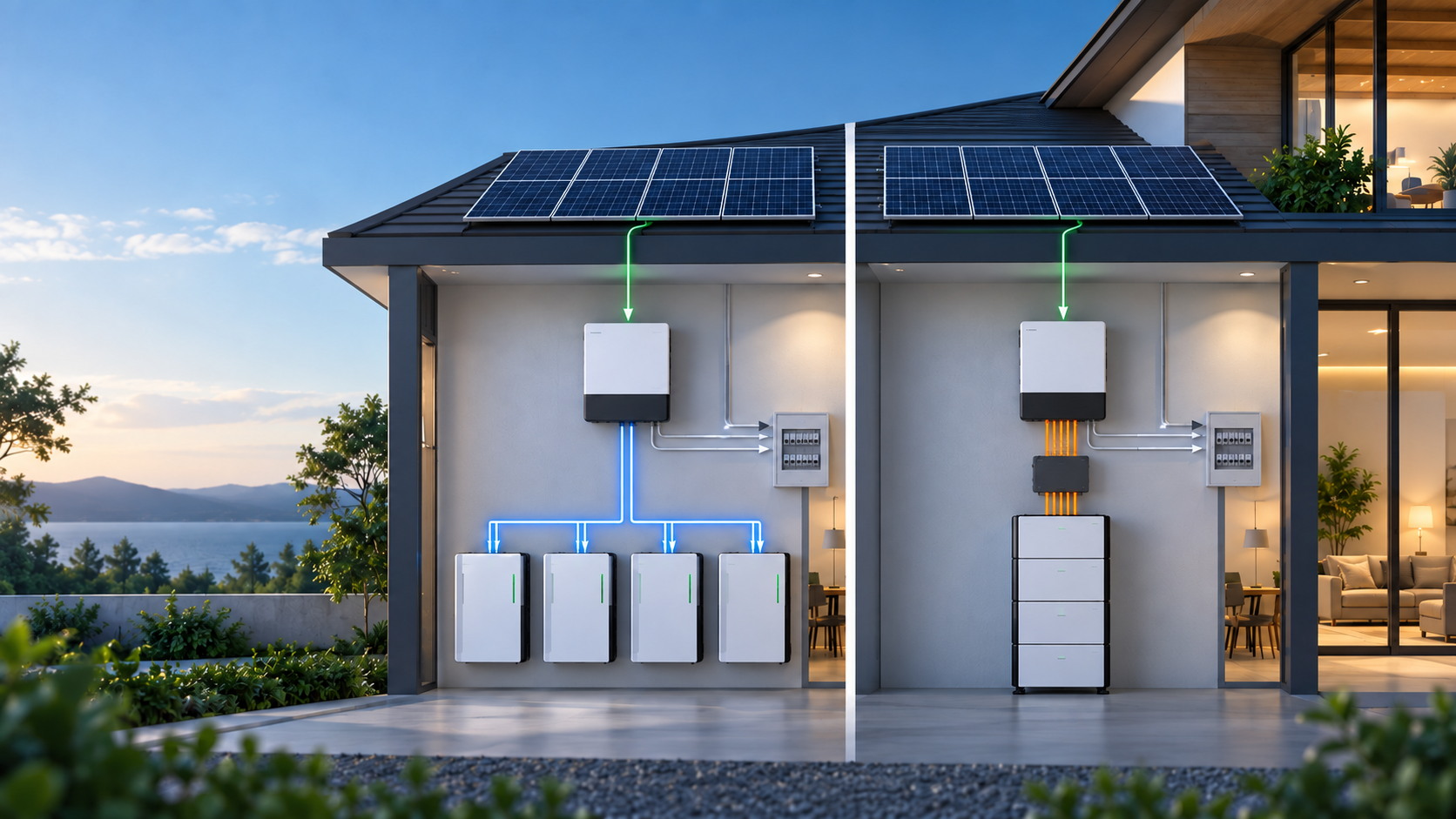
This comparison uses Deye’s residential product information and the Deye-approved battery documents available in the CVC Download Center. The downloadable guide condenses the calculations and quotation fields into a one-page reference.
Same power, different battery current
At the same output power, a lower battery voltage means a higher DC current. Use this first-pass calculation when reading a product datasheet:
| Inverter output | 51.2 V battery route | 200 V battery route | What the installer sees |
|---|---|---|---|
| 5 kW | ≈103 A | ≈26 A | LV needs a higher-current BMS, cable and protection path |
| 8 kW | ≈165 A | ≈42 A | Parallel LV battery units become more likely as power rises |
| 12 kW | ≈247 A | ≈63 A | HV reduces current in the DC path when the inverter and battery are designed as a pair |
The 200 V column is a calculation reference, not a universal Deye battery setting. Replace it with the selected battery’s nominal and operating voltage when preparing a quotation. Then compare the result with the inverter’s maximum battery current and the battery BMS continuous charge and discharge current.
What Deye low-voltage and high-voltage routes look like
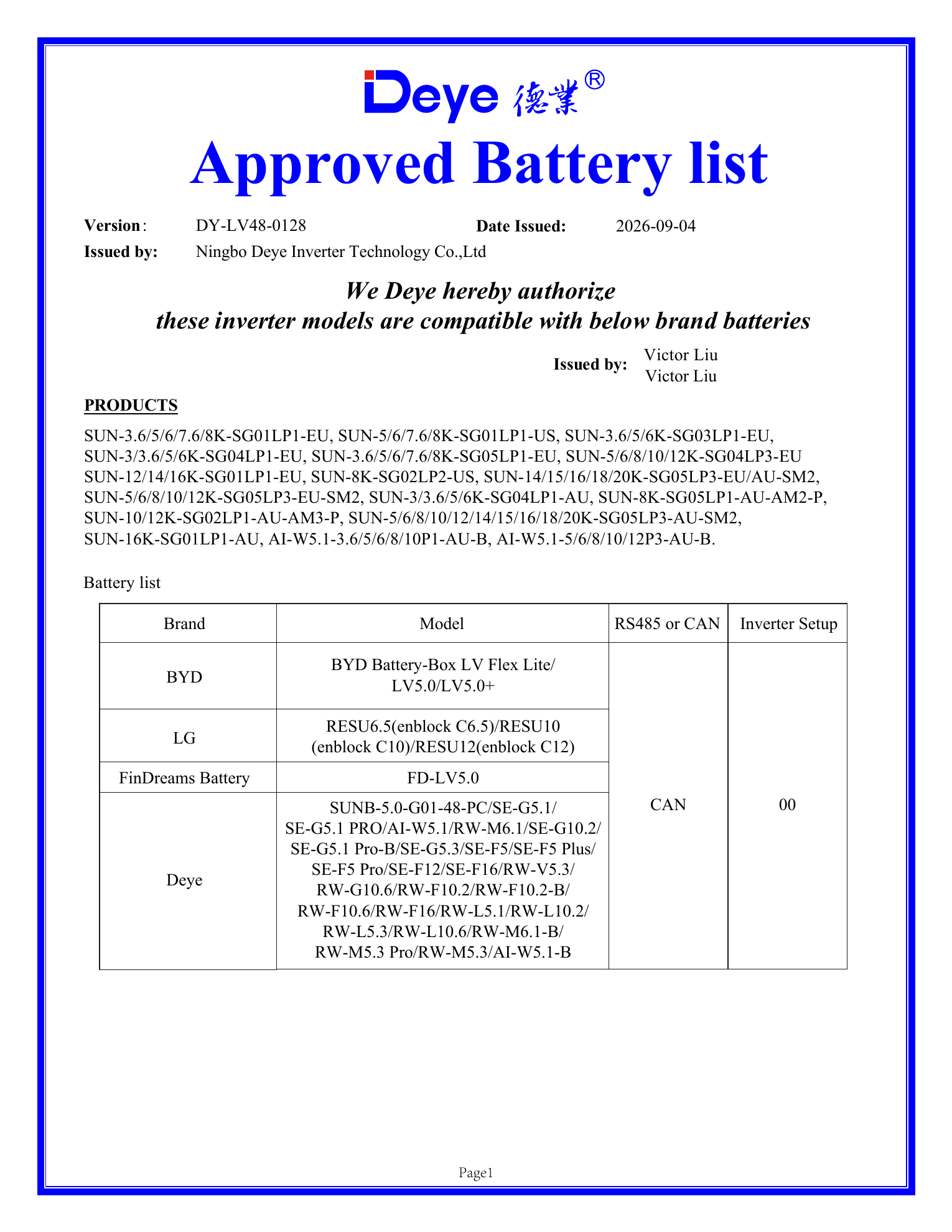
Deye’s low-voltage single-phase families include models with a 40–60 V battery range. The SUN-3/3.6/5/6K-SG04LP1-EU manual is one useful reference for this route. The exact charge and discharge current still belongs to the selected model: the 5 kW version is listed at 120 A and the 6 kW version at 135 A in the product information used for this guide.
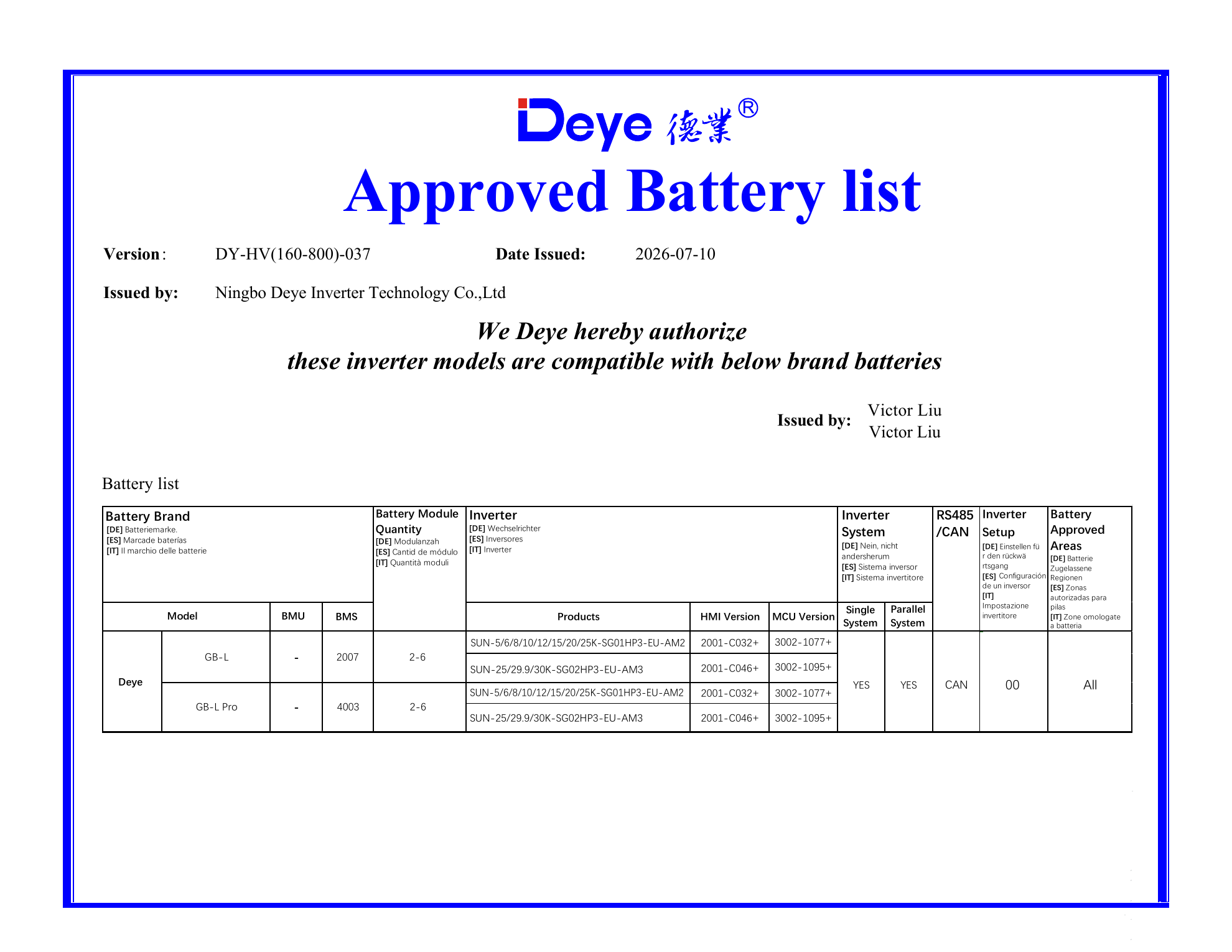
For high-voltage storage, Deye’s BOS-G battery uses 51.2 V, 5.12 kWh modules. Deye lists 3–12 modules in series, creating a nominal system range of 153.6–614.4 V and an operating range of 124.8–700 V. This is a genuine high-voltage battery stack, not a group of 48 V batteries connected in parallel.
| Route | Battery-side reference | Module arrangement | Quotation focus |
|---|---|---|---|
| Deye low voltage | 40–60 V or 48 V class, model-specific | Parallel capacity and current | Battery current, BMS rating, cable and approved LV list |
| Deye high voltage | High-voltage operating window | 51.2 V modules in series, such as BOS-G | Module count, system voltage, HV list and communication settings |
Use the Deye approved battery list guide when the project moves from architecture selection to model, protocol, firmware and setup-code verification.
Low voltage vs high voltage: the project comparison
| Project field | Low-voltage battery system | High-voltage battery system |
|---|---|---|
| DC current at the same power | Higher | Lower |
| Cable and protection | Large-current cable, fuse and busbar selection matter | Lower current can simplify the DC path, while HV-rated protection is required |
| Module connection | Parallel units increase capacity and current capability | Series modules build the operating voltage |
| Installation space | Often flexible for smaller residential banks | Stack height, service clearance and battery cabinet layout matter |
| Typical project | 5 kW backup, small homes, retrofit systems and selected three-phase LV systems | High-load homes, larger storage capacity and inverter families designed for HV input |
| Expansion logic | Add parallel battery units only within the BMS and inverter limits | Add approved series modules within the voltage and module-count limits |
Low voltage is not a “small system only” label, and high voltage is not automatically the better choice. The practical choice comes from the Deye inverter’s battery input, the load profile, the required current, the available battery models and the installation plan.
Three home projects and the right architecture
Example 1: 5 kW home backup
A typical backup board may contain lighting, a refrigerator, router, television, computer and selected sockets. At 5 kW, a 51.2 V calculation gives about 103 A at 95% efficiency. That makes a 48/51.2 V Deye route practical when the inverter accepts 40–60 V and the battery BMS can deliver the required continuous current.
For the quote, check the inverter’s maximum battery current, the battery’s continuous discharge current, the number of parallel units and the cable/protection plan. If the customer mainly wants essential-load backup, do not oversize the battery bank simply because the inverter nameplate shows 5 kW.
Example 2: 8–12 kW home with heavy loads
Air-conditioning, water pumps, induction cooking and electric water heating can push the battery side well beyond a comfortable single-unit LV current. The same calculation gives about 165 A at 8 kW and 247 A at 12 kW on a 51.2 V route.
At this level, compare three items as one package: the Deye inverter’s maximum battery current, the battery bank’s continuous current and the parallel-unit arrangement. A Deye low-voltage 12 kW model can still be a valid project route, but it needs the correct high-current battery configuration. If the selected inverter is a Deye HV model, use the matching HV battery family instead of trying to recreate the voltage with unrelated LV units.
Example 3: three-phase home
Three-phase describes the AC side. It does not decide whether the battery is low voltage or high voltage. Deye’s SUN-5/6/8/10/12K-SG04LP3-EU family is a useful reminder: a three-phase inverter family can use a 48 V low-voltage battery.
For a three-phase quotation, record the exact model suffix, phase arrangement, battery voltage range, maximum battery current and approved battery list. Then check whether the customer wants whole-home backup or only selected loads on the backed-up phases. The AC phase plan and DC battery architecture must be matched in the same project sheet.
For more detail, use the three-phase battery and inverter matching checklist.
Fields to record before the quotation
| Quotation field | What to enter |
|---|---|
| Inverter model | Full Deye model and regional suffix |
| AC architecture | Single-phase or three-phase; backup-load arrangement |
| Battery voltage class | Low voltage or high voltage, based on the inverter specification |
| Battery operating range | Nominal voltage and minimum/maximum operating voltage |
| Battery current | Maximum inverter current and battery BMS continuous charge/discharge current |
| Module arrangement | Parallel LV units or series HV modules, with quantity |
| Communication | CAN or RS485, pinout, protocol, firmware and setup code |
| Evidence file | Current Deye approved list, manual and commissioning record |
CVC can match the battery, inverter and supporting documents around these fields. Send the exact Deye model and the target load profile through the CVC contact page or request a sourcing check from the form below.
Download the Deye low-voltage vs high-voltage guide
Download the Deye Low-Voltage vs High-Voltage Battery Architecture Quick Guide for the current table, project examples and quotation fields in a compact PDF.
Sources used for the technical references
The voltage ranges, module arrangement and product references in this article are based on Deye materials: the Deye BOS-G product page, the Deye residential energy storage solution document, the Deye three-phase product reference and the Deye approved-list files linked in the CVC Download Center. CVC uses these sources to organise a project-level product matching and supply discussion.

Peter Yin
Need help matching a Deye LV or HV battery?
Send the Deye model, phase, target load and battery voltage route. CVC can organise a matched battery and supplier follow-up.