
Thailand is not a market where a new energy-storage channel has to start from zero. The country already has a sizeable rooftop-solar base, established electrical and solar distribution networks, and a new policy environment that makes the value of self-consumption easier to explain to homeowners.
A recent CVC project in Vietnam showed a different but related lesson: a customer can use a small private-label order to test a market and introduce a home battery brand without beginning with a large factory commitment. Thailand offers another kind of entry opportunity. Here, the commercial question is less about proving that solar can work and more about adding batteries, hybrid inverters and after-sales capability to channels that already understand rooftop generation.
For distributors, installers and adjacent energy businesses, the opportunity is practical. The strongest offer is not simply “a battery for every home.” It is a correctly matched battery-and-inverter system that helps a customer use more of their own solar power, reduce expensive grid purchases, maintain selected loads during an outage and understand the limits of local export rules.
Thailand already has the rooftop-solar base that storage needs
The demand case for home storage is stronger when a market already has solar assets in operation. Thailand’s Department of Alternative Energy Development and Efficiency (DEDE) reported that cumulative on-grid solar capacity reached 5,021.09 MW in 2023. Rooftop systems accounted for 1,775.19 MW across 24,276 projects, and rooftop capacity increased by 31.76% compared with 2022.
These figures are not a claim that every Thai home has solar. They show that rooftop PV is an established and expanding channel, with installers, electrical contractors, distributors and customers who already understand the basic solar proposition. That installed base creates a natural route for storage sales:
- Existing rooftop customers can add batteries when they want more evening self-consumption.
- New solar buyers can compare an export-only system with a solar-plus-storage package.
- Installers can add backup and energy-management services instead of competing only on panel price.
- Distributors can create a repeatable battery-and-inverter portfolio for common residential scenarios.
The next sale is therefore often an upgrade, a retrofit or a better-designed new system rather than a completely new category sale.
The economics are shifting from export to self-consumption
The idea that Thailand’s solar customers may now care more about self-consumption than export is directionally correct, but the detail depends on the utility, tariff class, location and customer eligibility.
For the Provincial Electricity Authority (PEA) 2026 residential rooftop programme, surplus electricity is purchased at THB 2.20/kWh for 10 years. The programme is for eligible residential users in the PEA service area, limits the offered export capacity to 5 kW AC per customer and is first-come, first-served. It should not be presented as an automatic nationwide rule for every Thai household, because Metropolitan Electricity Authority (MEA) customers follow their own process.
PEA’s published electricity tariff effective from September 2026 provides a useful comparison. For residential users consuming more than 150 kWh per month, the energy charge is THB 3.000/kWh for the first 200 kWh, THB 4.1584/kWh for the next 200 kWh and THB 4.3583/kWh above 400 kWh. The optional low-voltage TOU rate lists THB 5.7982/kWh in peak periods and THB 2.6369/kWh off-peak. These are energy charges before the Ft adjustment and VAT, not the complete bill.
The commercial implication is clear. In an eligible PEA example, one kilowatt-hour used inside the home can avoid a retail energy charge that is higher than the THB 2.20 export rate. During a peak period, the difference can be wider. A battery can move midday solar production into the evening, when household demand and the value of self-use may be higher. The exact benefit still requires the customer’s load profile, tariff, PV size, battery round-trip efficiency, installation cost and operating rules.
Demand drivers for home batteries in Thailand
1. Rooftop solar produces power before many homes need it
Solar production usually peaks during the day, while residential demand often continues into the evening. Air conditioning, refrigeration, water pumps, home offices, cooking equipment and electric-vehicle charging can extend the demand curve beyond the solar-production window.
Without storage, surplus generation may be exported under an applicable programme, curtailed by an export-control setting or used only when the home has a simultaneous load. A battery gives the installer another way to use that generation later.
2. Customers increasingly want resilience, not only bill savings
A home battery can be evaluated as backup power for selected circuits, not as a promise to run every appliance indefinitely. Refrigerators, internet equipment, lights, security systems, fans and selected air-conditioning loads may have different priorities from water heaters or high-power cooking equipment.
This creates a professional sales conversation. The installer needs to identify essential loads, starting power, expected backup duration, battery usable energy, inverter continuous power and the transfer arrangement. A smaller system that is correctly designed for priority loads can be more credible than an oversized system sold without a clear backup plan.
3. Export-control and local connection requirements matter
The customer may want zero export, limited export or approved surplus sales. These are different system objectives. The battery, hybrid inverter, meter, CT configuration, EMS and grid settings must work together. A product that is suitable for an off-grid backup project is not automatically approved for a grid-connected residential installation.
4. A mature solar channel can sell service around the product
Thailand’s solar market gives installers an opportunity to package site assessment, load analysis, commissioning, monitoring, maintenance and future battery expansion. Those services can make the offer less comparable than a panel-only quotation and can generate follow-up revenue from an existing customer base.
Businesses that can enter Thailand’s home-storage channel
Home energy storage is relevant to more than conventional solar companies. The most relevant prospects are businesses that already have customer trust, electrical knowledge, a physical sales channel or an installed base that can be upgraded.
Rooftop solar installers and EPC companies
These businesses already assess roofs, PV yield, wiring and grid connection. Adding batteries allows them to offer self-consumption and backup packages to existing solar customers. Their main capability gap is usually battery commissioning, inverter communication, protection settings and post-installation monitoring.
Electrical contractors, UPS dealers and generator companies
These channels understand power quality, backup priorities and service calls. They can position a battery system as a quieter and lower-maintenance alternative or complement to a generator, while using their existing knowledge of changeover equipment and critical loads.
Appliance, electronics and home-technology distributors
Retailers and distributors that already sell air conditioners, refrigerators, smart-home equipment or electrical accessories have access to homeowners and property projects. Storage gives them a higher-value system category, but they need local installation partners and a clear warranty escalation process.
Solar module and inverter importers
Importers that already supply installers can add a battery line to their portfolio. Their advantage is not only logistics. They can build a standard compatibility list, stock a small number of repeatable configurations and train their installer network on one commissioning process.
Home-improvement, property and premium-housing channels
Developers and home-improvement businesses can introduce storage as part of energy-resilient homes, especially where customers value backup, monitoring and an integrated appearance. The offer should be based on the building’s electrical design and local interconnection requirements, not on a generic capacity package.
Importers and local energy-storage brand owners
Companies that want a Thai home-battery brand can begin with a standard product platform, packaging and a documented support process. CVC’s OEM/ODM service can be considered when the business has a genuine channel plan. It still needs model-specific certification, nameplate, import and after-sales decisions, and it should not be confused with a complete hardware redesign.
Businesses building that route can also review CVC’s solar battery distributor programme to understand the type of technical and channel support that should sit behind a Thai portfolio.
What Thailand’s current policy means for storage sellers
Thailand’s current policy support is more direct for rooftop PV than for standalone home batteries. That distinction should shape the sales message.
Residential rooftop-solar tax deduction
Thailand’s Ministry of Energy announced a personal income-tax deduction for qualifying residential on-grid rooftop-solar equipment and installation costs, up to THB 200,000. The measure requires connection with MEA or PEA and a full electronic tax invoice, and the published period runs through 31 December 2028.
The announcement describes a rooftop-solar tax measure. It should not be simplified into a nationwide cash subsidy for an independent battery pack. Whether a battery component can be treated as part of a qualifying system must be checked with the customer’s tax adviser, installer and the current official rules.
PEA surplus purchase programme
PEA’s 2026 residential programme purchases eligible surplus electricity at THB 2.20/kWh for 10 years, with a maximum offered export capacity of 5 kW AC per customer. The programme is relevant to PEA customers who meet its conditions. It does not remove the need to check MEA rules, local interconnection procedures, inverter settings or the project’s actual load profile.
Policy takeaway for distributors and installers
Policy can lower the barrier to installing rooftop PV, while the tariff structure can increase the value of using solar energy inside the home. Storage sellers should therefore explain three separate value streams:
- Self-consumption: using solar energy later instead of buying as much electricity from the grid.
- Backup: keeping selected loads operating when the grid is unavailable.
- System control: managing export, charging, discharge and monitoring within the approved installation design.
The policy does not replace product evidence. A tax measure or surplus purchase programme does not prove that a particular battery has the right voltage, communication protocol, grid settings, protection, tropical-environment design or documentation for a project.

CVC product directions for the Thai market
CVC’s Thailand product strategy should start with repeatable battery-and-inverter combinations, not a catalogue of disconnected SKUs. The final recommendation must be based on the utility area, phase, voltage, PV array, priority loads, battery voltage, communication protocol and installation environment.
| Thai market scenario | CVC product direction | Why it can fit | Checks before quotation |
|---|---|---|---|
| Existing rooftop-solar home seeking modular backup or higher self-consumption | Firefly Low Voltage battery platform, 5.12 kWh, 48 V, stackable | A modular low-voltage format can support staged capacity and retrofit conversations | Usable capacity, maximum charge/discharge current, inverter voltage window, CAN/RS485 protocol and local grid settings |
| Larger villa or small business with longer evening loads | Firefly Max home battery, about 16.179 kWh, IP65 | Larger stored energy and an outdoor-oriented enclosure can support stronger backup requirements | Actual usable energy, installation clearances, thermal conditions, inverter power and approved installation arrangement |
| Three-phase home, premium property or larger installer project | CVC Three-Phase Hybrid Inverter range, 6–15 kW, IP65, matched with the selected battery | Three-phase output and hybrid operation can suit larger residential loads and professional installer packages | Phase balance, grid code, battery voltage, communication version, backup topology and export-control method |
| Larger self-consumption system or a project that also considers generator input | CVC DCDC Home Energy Inverter solution, 12/25 kW with an 8–48 kWh battery range | The published solution is positioned for PV, battery and generator-ready applications | Generator synchronization, reverse-power protection, battery current limits, load type and commissioning responsibility |
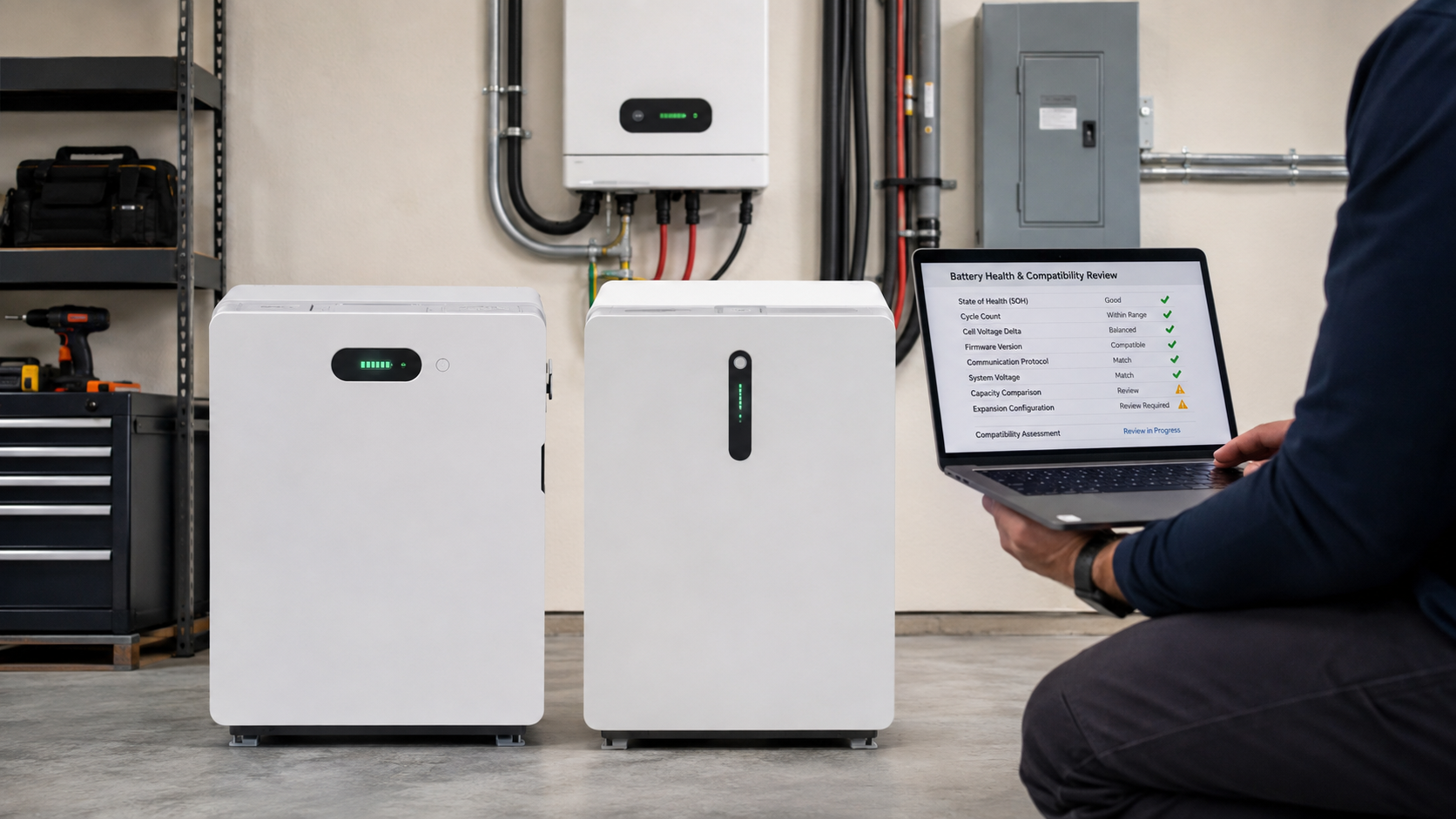
CVC’s Energy Storage Batteries and Inverter Solutions information lists compatibility with mainstream inverter brands such as Growatt, Deye, Solis, Victron and SMA, subject to final protocol confirmation. For Thailand, this should be treated as a starting point for a model-by-model compatibility review, not as a claim that every battery works with every inverter or that every combination is approved by PEA or MEA.
Before choosing a product package, the Thai distributor or installer should request:
- The exact battery and inverter model numbers, firmware versions and voltage ranges.
- The communication protocol, pin definition, CAN or RS485 settings and fault-handling logic.
- The grid-connection parameters for the intended utility area and phase configuration.
- The battery usable-energy calculation, continuous power limits and backup changeover method.
- Temperature, humidity, ingress protection, surge and installation-clearance information for the site.
- Datasheets, manuals, single-line diagrams, certificates, warranty terms and service escalation contacts.
A practical entry plan for Thailand
An adjacent-channel company does not need to build a nationwide portfolio on its first order. A more controlled sequence is:
Step 1: Start with one customer segment
Choose one route such as existing rooftop-solar customers, villa backup, small shops or generator replacement. Each segment has a different load profile, price expectation and service model.
Step 2: Build two or three repeatable configurations
For example, a modular low-voltage package for smaller homes, a larger battery package for longer backup and a three-phase package for larger properties. Keep the first catalogue narrow enough that installers can learn the system and keep critical spare parts.
Step 3: Validate the inverter and grid path before stocking
Compatibility should be confirmed with the exact model, firmware and protocol. The installer should also confirm whether the project is in PEA or MEA territory, whether export is allowed, and whether the selected inverter settings and protection meet the local process.
Step 4: Sell the service package with the hardware
Include site assessment, essential-load definition, commissioning, monitoring setup, warranty handling and a realistic maintenance process. This is especially important for channels entering storage from appliances or conventional electrical products.
Step 5: Use customer feedback to refine the portfolio
Track which capacities, inverter brands, backup loads, installation environments and service questions occur repeatedly. The next order should be based on evidence from Thai projects, not only on a supplier catalogue.
FAQ: Thailand home energy storage opportunities
Does Thailand currently offer a nationwide direct subsidy for home batteries?
No nationwide direct battery subsidy was confirmed in the current policy review. The clearest measures support residential rooftop solar through a tax deduction and a PEA surplus-purchase programme. Battery value should be assessed through self-consumption, backup and system-control benefits.
Is the THB 2.20/kWh surplus rate available to every Thai household?
No. The published 2026 programme is for eligible residential users in the PEA service area, with a 5 kW AC export limit and a 10-year purchase period. MEA customers and projects outside the programme require separate confirmation.
Is exporting solar electricity always less valuable than using it at home?
Not always, but the PEA tariff example shows why self-consumption can be more valuable for many customers. The answer depends on the customer’s tariff, time of use, load profile, battery losses, system cost and eligibility for an export programme.
Which CVC battery should a Thai distributor choose first?
There is no universal first SKU. A distributor should begin with the product direction that matches its target segment, then confirm the battery voltage, inverter power, communication protocol, grid settings and backup loads. Firefly Low Voltage is a logical modular direction for some 48 V residential applications, while Firefly Max or a three-phase hybrid package may fit larger backup requirements.
Conclusion: Thailand rewards complete system offers
Thailand’s rooftop-solar market gives distributors and installers a foundation for home-storage growth. The opportunity comes from the interaction of an established PV channel, a policy environment that encourages rooftop solar, a growing need to use more solar energy on site and customer demand for reliable backup.
For a new channel partner, the practical route is to select a narrow customer segment, build a small number of verified battery-and-inverter combinations and support them with installation, documentation and after-sales processes. CVC can help review the Thai project conditions through its Southeast Asia home energy storage solutions, select an appropriate battery and inverter direction, check compatibility and define a supply or private-label route before a larger inventory commitment.
If you are evaluating Thailand home energy storage products, contact CVC and share your utility area, PV size, target customer, inverter preference, expected quantity and priority loads with the technical team for a project-level review.
Sources and policy boundaries
- Thailand DEDE solar PV status: cumulative on-grid and rooftop capacity
- PEA 2026 residential rooftop-solar surplus purchase programme
- PEA electricity tariff structure effective September 2026
- Thailand Ministry of Energy: residential rooftop-solar tax deduction
Policy information was checked on 26 August 2026 and is used to explain market conditions, not to provide legal, tax or investment advice. Eligibility, interconnection, tariff treatment, equipment acceptance and tax treatment must be confirmed with the relevant Thai authority, utility, installer and professional adviser before a quotation or project decision.
—

Peter Yin
Discuss a Thailand Home Energy Storage Opportunity
Tell us your utility area, PV size, target customer, inverter preference, expected quantity and priority loads. We will help map a practical battery-and-inverter route for Thailand.