
A multi-day outage is a charging problem, not only a capacity problem
Short answer: a portable power station multi-day outage charging plan should connect four decisions: which loads must remain available, how much energy they use each day, when AC/PV or generator power is available, and how much charging the station can actually accept. A larger Wh label helps only when the product can be recharged during the outage and the customer operates it within its output limits.
This is different from asking how long one portable power station can run lights, fans and a router. That is a runtime question. During a two- or three-day outage, the distributor must also plan how the battery is replenished, which loads take priority and how much reserve remains for the next interruption.
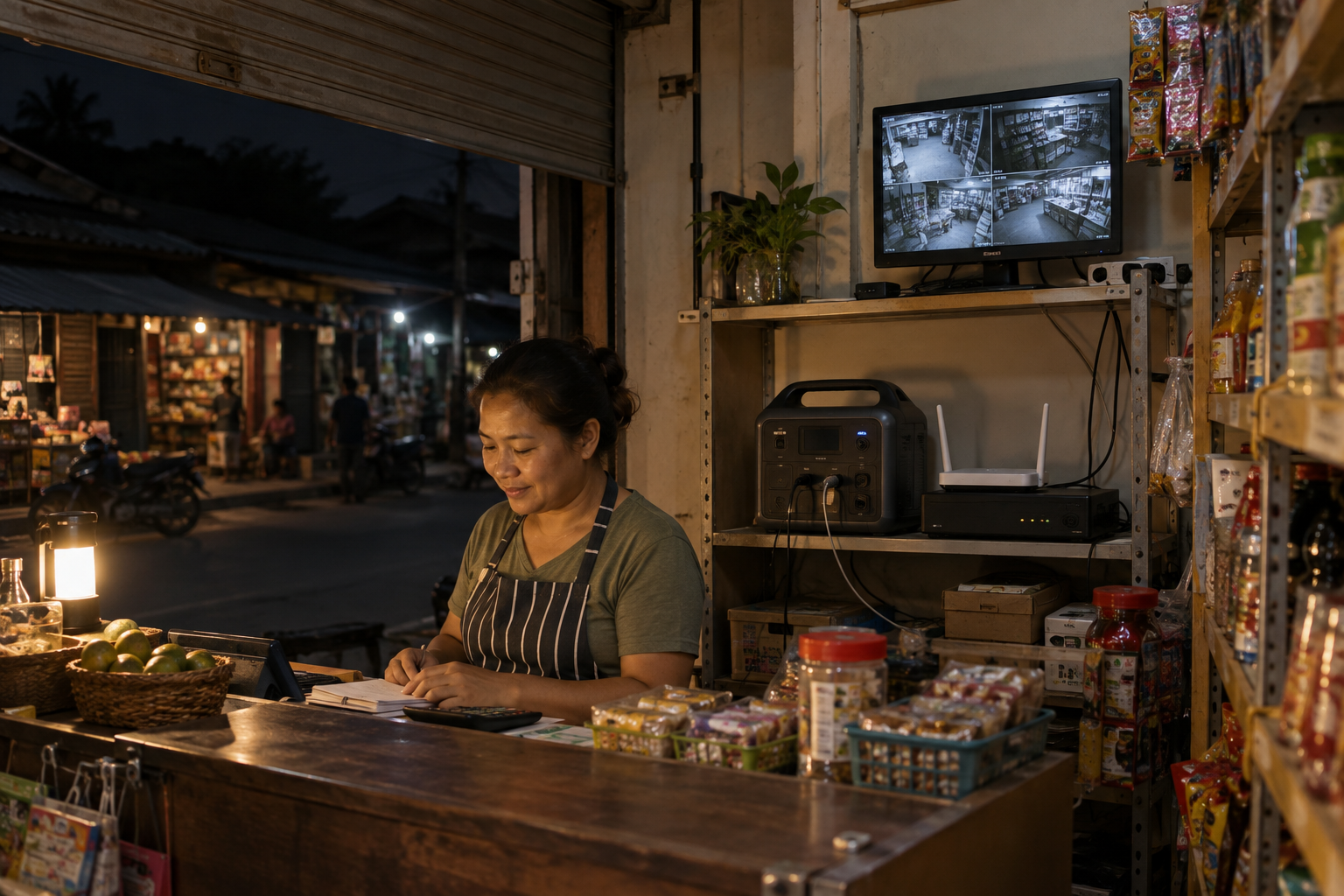
Start with a three-day load schedule
Before discussing a model, write the outage as a schedule. A household, kiosk, clinic room or small office may not need every appliance running continuously. It may need communications, security and a few essential services to remain available at different times.
| Load group | Operating plan | Evidence to confirm |
|---|---|---|
| Router, modem and phone charging | Keep communications available; charge phones in planned windows instead of leaving adapters connected all day. | Adapter wattage, number of devices and expected daily charging sessions |
| LED lighting | Use only the rooms or work areas required during the outage; turn off circuits that are not needed. | Number of lamps, wattage and evening operating hours |
| Refrigerator or freezer | Keep the appliance on a protected output only after checking startup behavior and the station’s continuous/peak output. | Running watts, compressor startup, duty cycle and plug type |
| Fan or small office load | Rotate with other comfort or work loads instead of adding every load at the same time. | Running watts, start behavior and priority during hot periods |
| Water pump or shop equipment | Run in short, deliberate windows when the station and inverter output are suitable; do not assume any pump will start. | Motor surge, running watts, cable length and required operating time |
This schedule gives a distributor a better sales conversation. It also exposes when the customer is asking a portable product to serve a whole building, a motor load or an always-on refrigerator without providing the necessary electrical data.
Calculate the daily energy budget before choosing a station
A practical first calculation is:
For example, a distributor may model three LED lights at 10W each for six hours, a 12W router for ten hours, phone charging at 60Wh per day and a 55W fan for four hours. The screening total is 180Wh + 120Wh + 60Wh + 220Wh, or 580Wh per day before system losses. If the customer also adds a refrigerator or pump, the calculation must use the appliance’s measured or documented operating profile and startup requirement.
For a three-day outage, multiply the daily plan by three, then subtract only the energy that can be reliably restored from PV, AC or a generator during the outage. The result is not a promise of fixed runtime. It is a planning model that shows whether the proposed station, charging source and load rotation are internally consistent.
Map the three recharge paths: AC, PV and generator
AC charging during an available grid window
In a rolling or intermittent outage, the grid may return for a short period. Record the likely charging window and the station’s accepted AC input. A product that can accept more input may recover a larger portion of the daily energy budget, but the actual result still depends on the source voltage, charging profile and time available.
Solar charging during daylight
PV can extend the useful period of a portable station, but panel nameplate watts do not equal energy delivered to the battery. Check the station’s PV voltage window, maximum input current, maximum input power, connector and cable arrangement before creating a bundle. Our portable power station solar panel matching guide for Africa covers these checks in detail.
Generator charging when the grid is unavailable
A generator can provide a recharge window, but the distributor must confirm the generator output quality, frequency, voltage, fuel plan, noise constraints and station input requirements. Do not assume that any portable station can be connected to any generator, or that a generator rated for a higher output will make the station charge faster than its input limit allows.
Why the station input limit decides whether the battery recovers
The most common planning error is to calculate the energy needed but ignore the rate at which the station can recover it. Suppose the selected load schedule uses 1,200Wh in one day and the site has a four-hour recharge window. The system needs an average of 300W delivered to the battery just to replace that energy, before charging and conversion losses. If the station’s accepted input is lower, the missing energy becomes the next day’s deficit. If the source is intermittent, the recovery window becomes even shorter.
This is why a portable power station recharge plan should record both the daily Wh target and the effective charging input. The product decision needs at least:
- Daily load energy and the expected operating schedule;
- AC, PV and generator availability by time of day;
- Maximum accepted input for each charging path;
- Whether the station can charge while selected loads remain connected;
- How much SOC reserve is held back for communications, security or medical priorities.
When a datasheet gives conflicting input values, stop the quotation and request the exact model revision, manual and test condition. Do not use a generic series specification to create a multi-day promise.
Use load rotation and a reserve SOC rule
Load rotation is the commercial difference between a workable portable backup package and an oversized promise. Set a simple order of priority:
- Protect communications: router, modem, phones and essential charging.
- Protect security: selected lights, CCTV or alarm equipment where the product output is suitable.
- Protect time-sensitive appliances: refrigerator or freezer only after startup and output checks.
- Schedule comfort and work: fans, laptops, POS equipment and small office loads in defined windows.
- Run motor loads last: pumps and compressors require a separate surge check and should not be added to a basic portable SKU promise.
Choose a reserve rule that the sales team can explain. For example, the user may keep a defined SOC band for evening communications and security instead of consuming the entire battery during the afternoon. The exact percentage depends on the model, battery protection and project requirement; the principle is to preserve a reserve for the next priority window.
Build a distributor SKU ladder instead of one universal model
A portable power distributor Africa portfolio is easier to sell when each SKU has a clear job. A practical first shortlist can include:
| Portfolio route | Customer fit | Before quotation |
|---|---|---|
| Compact 500W-class station | Lighting, router, phones, POS and selected short-duration loads. | Confirm usable energy, output surge, AC/PV input, plug, documents and target price band. |
| 1kWh-class portable station | Households, small shops and mobile users needing a longer selected-load window. | Confirm the load schedule, daily energy budget, charging sources and sample route. |
| 2kWh-class or higher-output station | Longer backup windows or selected larger loads where weight, price and transport remain acceptable. | Confirm output, startup behavior, input limit, PV bundle, packaging and after-sales process. |
Use the CVC Portable Power product range as the commercial starting point, then match the market and loads to the right product class. The existing runtime guide is useful when the customer asks for an hours estimate; this article should remain focused on the recharge cycle and the distributor’s range planning.
What to ask before adding a model to an African outage portfolio
Africa is not one electrical or commercial market. Before importing a model, record the target country or countries, local voltage and plug, customer channel, outage pattern as described by the buyer, seasonal solar conditions, generator availability and the loads the channel most often supports.
- What is the target country, plug standard and AC voltage?
- Which three loads must be supported first?
- Is the expected outage one evening, repeated daily windows or several continuous days?
- Can customers recharge from AC, PV, a generator, a vehicle or more than one source?
- What are the station’s exact input limits and can the supplier provide the current datasheet and manual?
- Does the channel need a 500W, 1kWh and 2kWh ladder, or only one validated entry SKU?
- What sample quantity, packaging, warranty, RMA and replacement route are required?
These questions turn a broad “portable power for Africa” request into a distributor shortlist with a defined evidence trail. They also keep a sales team from using the same product promise in a city apartment, a rural shop, a mobile work case and a small cold-chain application.
FAQ: multi-day portable power charging
Can solar alone recharge a portable power station during a multi-day outage?
It can contribute substantially when the panel array, weather, daylight window and station input limits are compatible. It should not be treated as a guaranteed daily replacement without a site-specific load and PV review.
Can a portable power station be charged from a generator?
Only after the station’s AC input requirements and the generator’s output are checked. Confirm voltage, frequency, waveform, connector, charging behavior and the supplier’s documentation before putting the combination into a sales package.
Should a distributor always choose the largest battery?
No. A larger unit may add weight, cost, transport difficulty and slow-moving inventory. The better choice is the smallest validated class that meets the load schedule, output requirement and recharge plan.
What if the customer has no solar or generator?
Plan for shorter operating windows, strict load rotation and a reserve for critical loads. If the available grid windows cannot restore the daily energy budget, a portable unit should not be presented as continuous multi-day backup.
Can the same station run a refrigerator, router and water pump?
It may be possible only for a specific model and operating schedule. Check compressor and motor startup, continuous output, peak output, battery energy, input limit and the required sequence. Do not combine these loads from a Wh number alone.
The distributor decision
The right portable power station multi-day outage charging plan starts with a daily load schedule and ends with a validated SKU ladder. Between those two points, the buyer must check AC, PV and generator windows, input limits, load rotation, reserve SOC, documentation and after-sales responsibility.
For a real project, send the target country, key loads, expected outage duration, available recharge sources, sample quantity and target channel. CVC can then help turn the use case into a practical portable power shortlist for selected African markets.

Peter Yin
Build a portable power shortlist for a multi-day outage
Send the target country, key loads, expected outage duration, available recharge sources, sample quantity and target channel. CVC can help organize a distributor shortlist for selected African markets.