
“Yes, this battery is expandable.”
That sentence appears in many quotations. It sounds reassuring, but it leaves out the part that matters three years later: expandable with which model, at what age, under which firmware, and with whose written approval?
Adding storage after the first installation is often possible. It is not automatic. A new battery can have the same brand name and the same nominal voltage as the old one and still be a poor match for the existing system.
Quick answer: You may be able to add another battery later, but you need to check the exact battery model, voltage platform, usable capacity, BMS protocol, firmware, state of health, inverter limits, approved parallel quantity and warranty terms before ordering the new module.
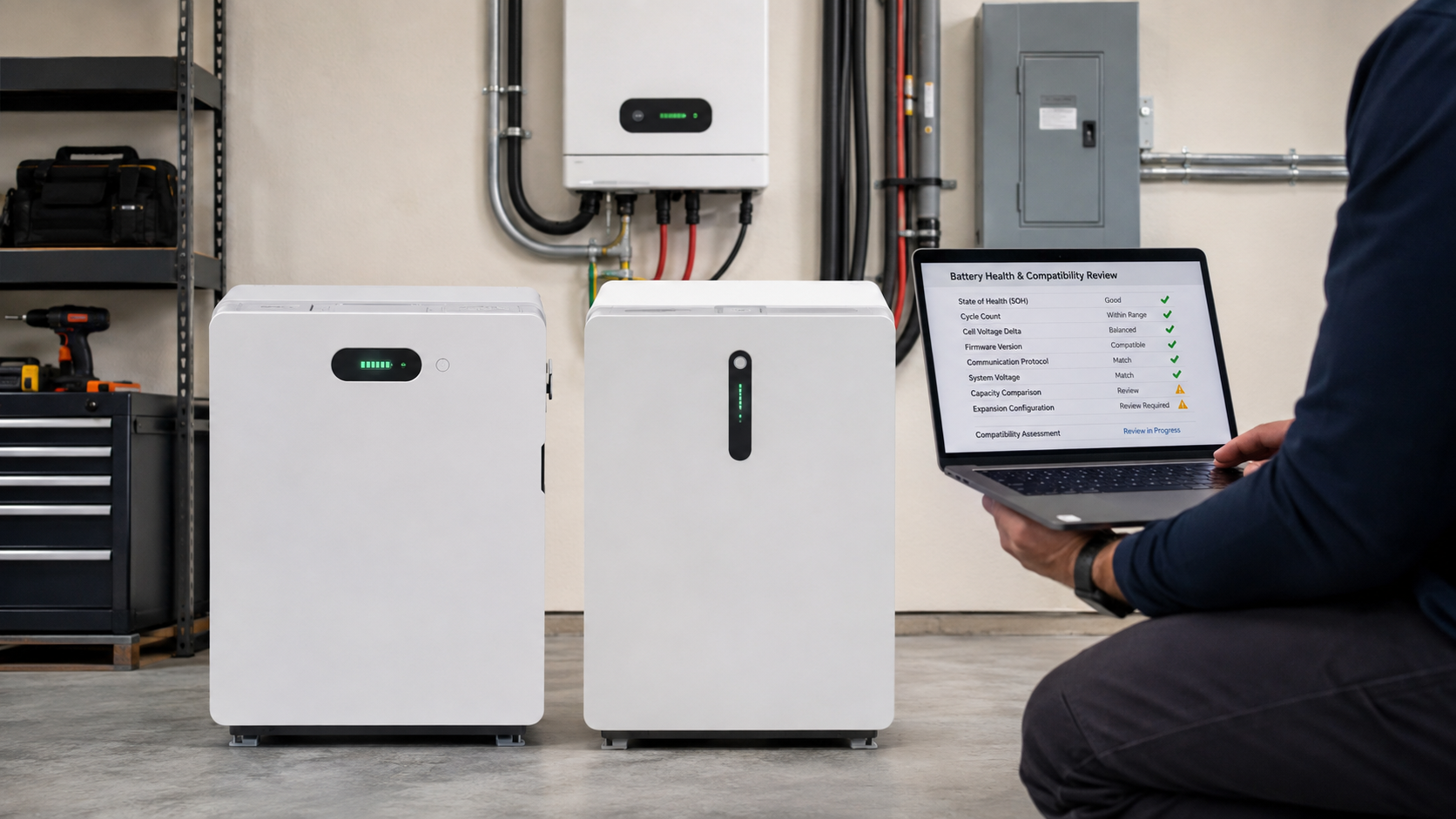
“Expandable” can mean four different things
Suppliers use the word expandable for several system designs. Ask which one the quotation actually describes.
| Expansion route | What changes | What can stop the project |
|---|---|---|
| Add the same battery model in parallel | Battery kWh and available current may increase | Model, BMS, age, cable, protection or inverter limits |
| Add approved modules to a stack | The system grows within a defined product family | Stack height, module generation, firmware and controller limits |
| Add a separate AC-coupled battery system | A second battery and inverter system is installed | Space, energy management, transfer logic and local rules |
| Replace the original battery with a larger bank | The old battery is removed and the system is rebuilt | Cost, disposal, inverter compatibility and warranty reset |
These routes do not deliver the same result. Adding battery capacity increases stored energy. It does not automatically increase the inverter's AC output power. If the inverter can deliver 5kW, connecting more batteries does not turn it into a 10kW inverter.
A real product example: expansion numbers are not a lifetime promise
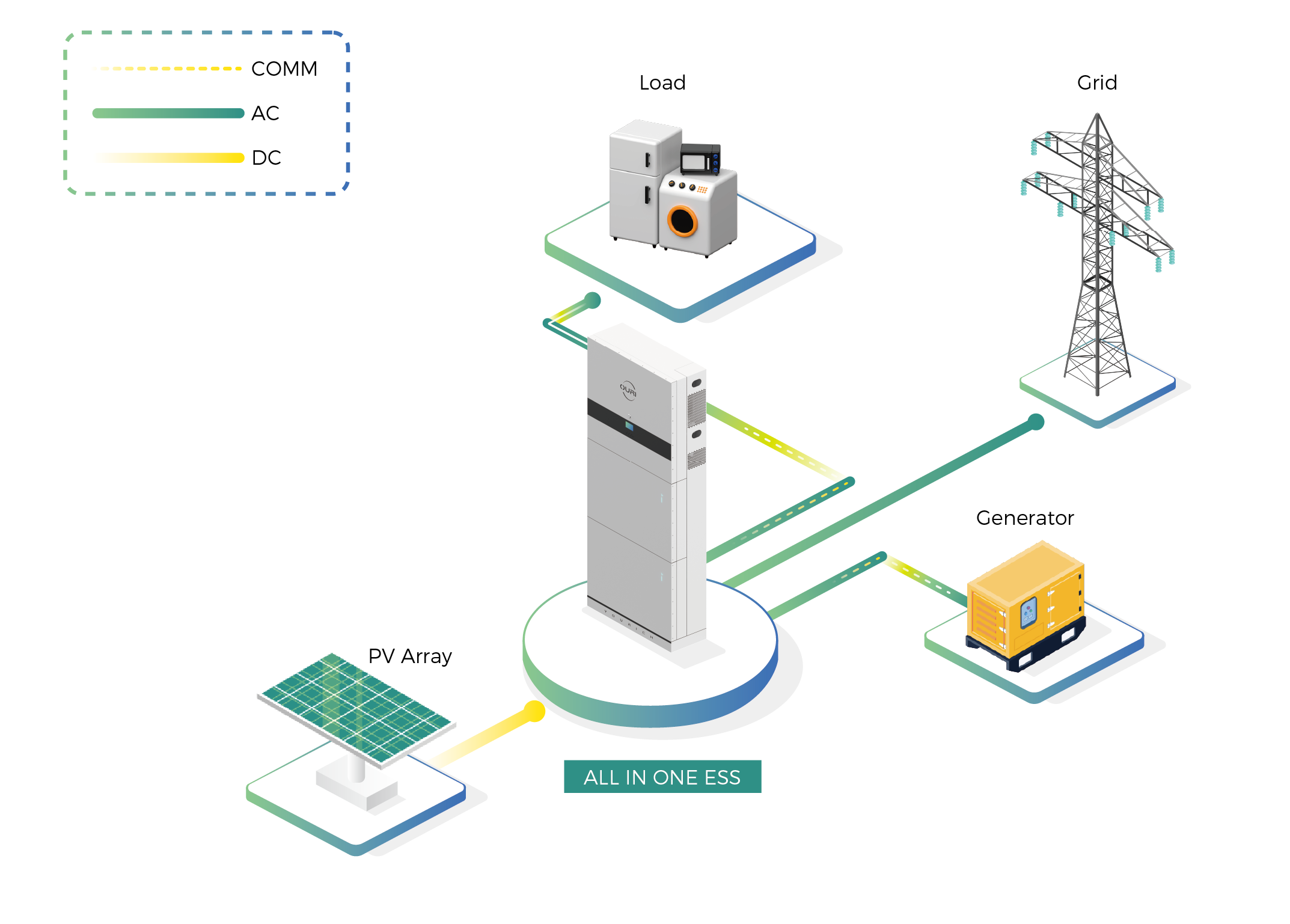
CVC's Firefly Low Voltage product material describes a 51.2Vdc LiFePO4 family with 3.6kWh, 7.2kWh, 10.8kWh and 14.4kWh configurations. It lists CAN, RS485 and WiFi communication, and states that expansion can reach up to three systems and 43.2kWh, subject to system design.
That is useful information for a new quotation. It tells an installer that the platform has a defined expansion path today. It does not guarantee that an identical module will still be available three years from now, or that a new module can be mixed with an older one without a health and firmware review.
The same point appears in the Firefly Max material. The product data lists 16.179kWh nominal capacity, 14.561kWh usable capacity and up to 15 units in parallel, subject to system design. Those are current product and system limits. They should not be rewritten as a promise of future spare-part availability.
The broader energy storage battery portfolio is useful for comparing platforms, but expansion still depends on the exact model, system limits and written approval.
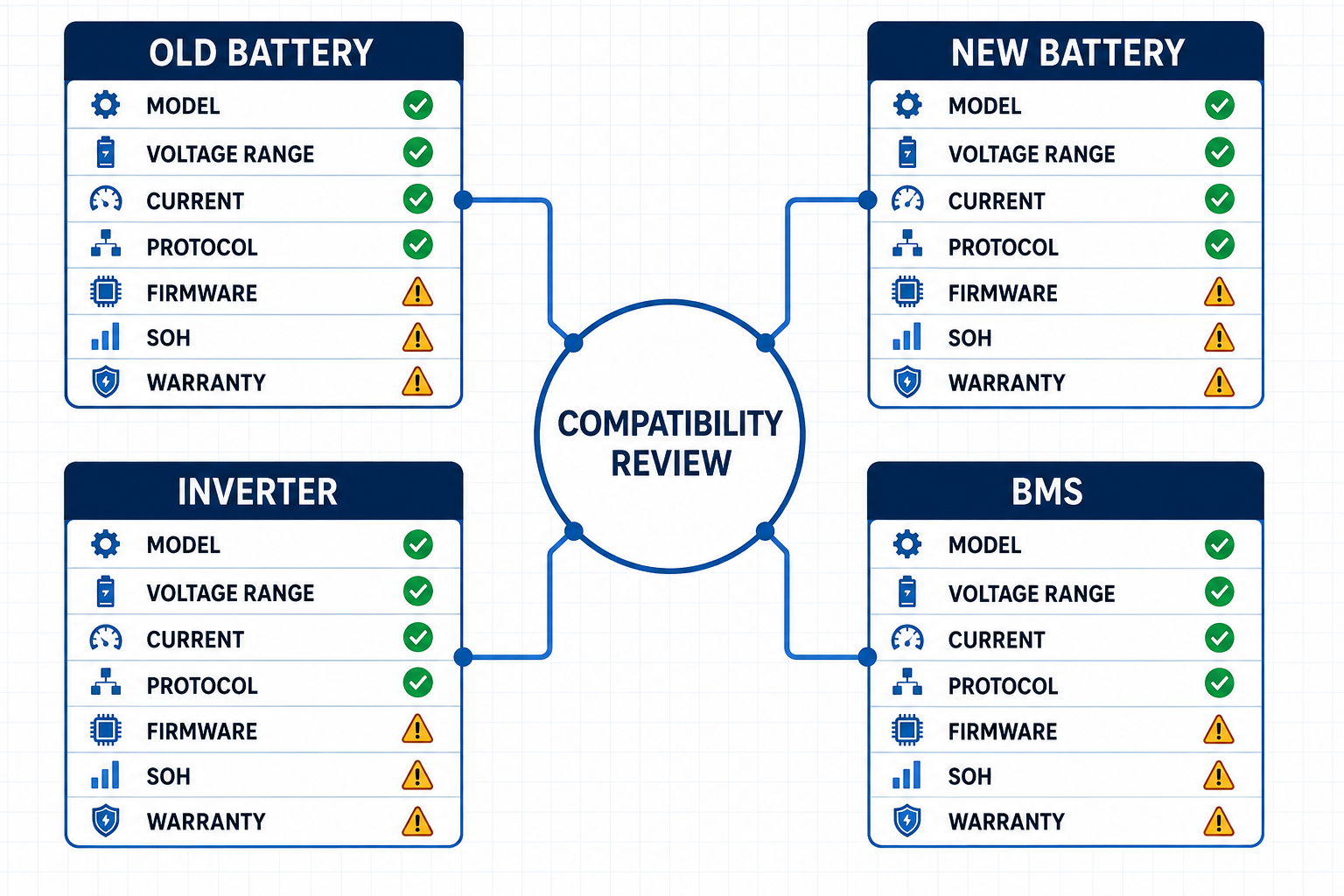
The numbers that must match before you add a battery
“Both batteries are 51.2V” is not enough.
For example, CVC's IPL-51314H is specified as a 51.2V, 314Ah, 16kWh LiFePO4 battery. Its published operating voltage range is 43.2V to 57.6V, with CAN2.0 and RS485 communication, a maximum continuous charge and discharge current of 157A, and up to 32 parallel units. Those figures describe that model. They do not make it an automatic expansion partner for every other 51.2V battery.
The nominal energy calculation is simple:
51.2V × 314Ah ÷ 1,000 ≈ 16.08kWh
The integration decision is not simple. Before placing the new order, compare the original battery and the proposed battery using the fields below.
| Check | What to compare | Why it matters |
|---|---|---|
| Model | Full model number and product generation | Brand-level matching is too broad |
| Chemistry | LiFePO4 cell chemistry and approved configuration | Different cell behaviour changes the charge and discharge response |
| Voltage | Nominal voltage and operating range | A similar label may hide different cut-off limits |
| Capacity | Ah, nominal kWh and usable kWh | The BMS and inverter may calculate SOC differently |
| Current | Continuous and peak charge/discharge limits | The parallel bank must share current within approved limits |
| Communication | CAN, RS485, protocol profile and register map | A connector that fits does not prove usable communication |
| Firmware | Battery, master BMS and inverter versions | New firmware may change alarms, SOC logic or addressing |
| Health | SOH, internal resistance, cell balance and cycle history | A three-year-old battery may not behave like a new module |
| Physical installation | Rack, stack, cable length, breaker, ventilation and access | Unequal resistance and poor service access create system problems |
| Warranty | Written approval for the exact mixed configuration | Verbal compatibility does not settle warranty responsibility |
Why a three-year gap changes the answer
The battery did not remain frozen while it sat on the wall. It accumulated charge and discharge cycles, calendar age, firmware updates and service history. The inverter may also have changed its software or communication profile.
Three years later, check these questions before comparing prices:
Is the original model still produced?
If the model has been discontinued, ask for the official replacement model and a written compatibility statement. “Same voltage” is not a replacement policy.
Is the original firmware still supported?
The new module may ship with a different firmware version. Confirm whether the modules can use one approved version, whether a firmware update is required and who performs it.
How healthy is the installed battery?
Request a BMS report that includes SOH, cell voltage spread, temperature history and fault history. The exact acceptance limits should come from the manufacturer or system integrator. Do not invent a universal SOH threshold and apply it to every battery family.
What does the inverter allow?
The inverter may limit the maximum battery current, number of battery units, usable voltage range or supported protocol. If the system is already close to its current limit, adding capacity may increase runtime without increasing the output power available to the loads.
Does the warranty cover the new configuration?
The answer should be written into the quotation or technical agreement. It should identify the original battery, the new battery, the inverter, the approved wiring or controller and the party responsible for commissioning.
Commercial rule: “Expandable” describes a design intention. A three-year expansion requires a model-specific compatibility decision and a new commissioning record.
Supplier answers that are not enough
When a supplier replies quickly, compare the sentence with the evidence it should produce.
| Supplier answer | What you should request instead |
|---|---|
| “Our battery supports expansion.” | Maximum quantity, approved topology and exact model list |
| “The new battery is the same brand.” | Full model, generation, voltage range and BMS compatibility |
| “It is also 51.2V.” | Operating voltage, current limits, SOC logic and communication profile |
| “The inverter is compatible.” | Inverter model, firmware, protocol and approved battery configuration |
| “You can add more later.” | Product lifecycle plan, replacement model and spare-module availability |
| “The warranty will be fine.” | Written warranty treatment for the mixed or expanded system |
| “The installer can configure it on site.” | Installation procedure, addressing method, balance requirements and acceptance test |
This is where many expansion projects become expensive. The battery price is visible. The missing documentation, return shipment, site visit and warranty argument arrive later.
A practical three-year expansion review
Use this sequence before requesting a final price.
- Collect the original quotation, datasheet, manual, serial number, installation date and commissioning record.
- Record the inverter brand, model, firmware, battery protocol and current battery quantity.
- Read the existing BMS data and save the SOH, SOC, cell voltage spread and fault history.
- Compare the original and proposed batteries line by line, including model generation and communication settings.
- Confirm the inverter's maximum battery current, voltage range and approved parallel quantity.
- Ask the supplier to state whether the new module can be mixed with the existing module and under what conditions.
- Get the warranty position in writing before payment.
- After installation, test battery recognition, SOC synchronisation, charge current, discharge current, alarms, monitoring and backup output.
The commissioning report should identify which battery is old, which module is new, the firmware versions used, the test conditions and the person who approved the final configuration.
The better way to specify an expandable battery at the first order
If future expansion matters, do not ask only for today's capacity. Add future supply to the original specification:
- initial model and capacity
- expansion model or approved replacement model
- maximum expansion quantity
- expected product lifecycle and last-order notice
- firmware control and update responsibility
- minimum documentation kept for each battery batch
- procedure for mixing new and existing modules
- warranty treatment after expansion
- spare parts and after-sales response
This turns “expandable” into something that can be quoted, tested and supported.
CVC's home battery supplier checklist for installers and battery-inverter compatibility article cover related checks. For a project that includes a new battery family, send the installed model, inverter model, installation date, target capacity and destination market through the contact page.
Common questions
Can I add another battery to my solar system after three years?
You can add another battery after three years only when the exact model, battery health, firmware, inverter limits, communication protocol and the manufacturer's written approval all support the expansion. The installation date alone does not decide compatibility.
Can I mix a new battery with an old battery of the same brand?
Do not assume so. The model, generation, voltage range, BMS, SOH and firmware all need to be checked. Some manufacturers approve the combination. Others require the modules to match more closely or require a full battery-bank replacement.
Does adding more batteries increase inverter power?
No. It usually increases stored energy and may improve available DC current, but the inverter's rated AC output remains the inverter's rated AC output.
Is a higher nominal kWh always better for expansion?
No. Usable capacity, current capability, inverter compatibility, installation space and future module supply matter just as much as nominal kWh. CVC's guide on comparing energy storage batteries beyond nominal capacity explains this broader check.
The buying rule
If you may need more storage later, treat expansion as part of the first purchase. Ask for the future model, future firmware path, future warranty treatment and future supply plan before you approve the first battery.
The useful question is not “Can this battery be expanded?” It is “Can this exact system still be expanded, supported and documented three years from now?”
For a product and compatibility review, send the original battery datasheet, inverter model, installation date and desired capacity to the CVC contact team.
Plan your next battery expansion
Send the installed battery model, inverter model, installation date, target capacity and destination market. We can help you review the expansion path before a new battery is ordered.