
When the power goes out, the useful question is not simply “How many watt-hours does this portable power station have?” A shop owner may need to keep a refrigerator cold, a fan running and a 4G router online. A household may also need to run a water pump for a short period.
Those loads do not behave in the same way. A router is a small electronic load. A fan has a relatively steady motor load. A refrigerator cycles its compressor on and off. A water pump can demand a large starting current. Matching them to a portable power station means checking the connection, the inverter output and the stored energy together.
This guide uses specific models as reference points. They are not presented as an official ranking of Africa’s best-selling appliances. Product specifications can vary by market, revision and nameplate, so the exact appliance label and current manual should always take priority.
Begin with the appliances, not the battery label
For a realistic calculation, we can use models documented by manufacturers or found in Nigerian market references:
| Load | Reference model | Published reference data | Matching question |
|---|---|---|---|
| Refrigerator | Haier Thermocool HRF-250BLUX | 215L net volume; 200W input; 220–240V / 50Hz | Can the AC inverter handle compressor start-up? |
| Standing fan | Binatone A-1691 MK2 | The public page shows both 50W and 55W references | What does the nameplate on the supplied unit say? |
| 4G router | TP-Link TL-MR6400 | 12V / 1A external power supply | Is there a compatible 12V DC output and connector? |
| Water pump | Pedrollo NGAm 1A | 1HP class; approximately 0.75kW; single-phase 230V reference | Is the station’s inverter large enough for the motor? |
The different numbers already show why one universal “portable power station size” is not enough. A refrigerator and fan may fit within a moderate continuous output on paper, while a 1HP pump can exceed that output before its starting surge is considered.
First, understand what AC and DC mean in daily use
AC, or alternating current, is the electricity normally supplied by a household wall socket. A conventional refrigerator with a standard mains plug is an AC appliance. It normally connects to the household-style AC output socket on the power station.
DC, or direct current, is the type of electricity stored by the battery and used by USB devices, car batteries and many network devices. A phone connected to a USB port is using a low-voltage DC output. A 12V router may use a direct DC connection, but only when the voltage, current, connector size and polarity all match.
The basic energy path is simple:
Battery stores DC energy → inverter converts DC to AC → AC socket powers a normal household appliance.
For a compatible DC appliance, the inverter step may be avoided: battery → matching DC or USB output → router, phone or 12V/24V appliance.
Read one appliance from its label to the power station
Refrigerator: check both running power and compressor start-up
The Haier Thermocool HRF-250BLUX product page lists a 200W input, 220–240V / 50Hz supply and 215L net volume. Its ordinary household plug points to the AC route: refrigerator plug → power station AC output.
The 200W figure is the starting point for the calculation, not the whole decision. A compressor can draw more power for a short period when it starts. The exact requirement depends on the compressor, voltage, temperature and starting condition. Look for a starting-current or surge figure in the manual, measure the exact appliance with a suitable power meter, or obtain a confirmed test result.
A refrigerator also cycles. It may not draw 200W continuously for every hour. Door openings, ambient temperature, food load and ventilation change the duty cycle. A runtime calculated from 200W continuously is therefore a planning estimate, not a field guarantee.
Fan: the easy load, but still use the supplied nameplate
The Binatone A-1691 MK2 is a practical fan reference. Its public product page contains both a 55W “Power” reference and a later 50W / 230V–50Hz reference. Use the higher 55W figure for planning until the nameplate or manual confirms otherwise.
Router: match voltage and connector before counting watts
The TP-Link TL-MR6400 is listed with a 12V / 1A external power supply. That is a useful upper-bound reference for the adapter—12W—not a guarantee that the router consumes 12W continuously.
If the power station has a regulated 12V DC output and the correct connector, direct DC power may be more efficient than using the router’s AC adapter through the inverter. If the connector or polarity is not confirmed, use the original adapter through the AC socket instead of improvising a cable.
Water pump: the short runtime does not make the motor small
The Pedrollo NGAm 1A material provides a 1HP-class, single-phase 230V reference in the approximately 0.75kW range. That is about 750W of motor power before start-up demand.
The pump may run for only a few minutes, but the power station still has to start and carry the motor at that moment. Pump matching requires the exact motor rating, starting behavior, cable length, water head and operating schedule.
Do two calculations—not one
Calculation 1: output power in watts
Add the loads that may operate at the same time:
Refrigerator: 200W
Fan: 55W
Router: 12W adapter rating
Total: 267W
On paper, 267W is below the 500W rated output of the REVO MP 1000Wh configuration used later as one reference product. That does not yet prove that the refrigerator compressor will start. The station’s continuous output, peak output and the refrigerator’s start-up requirement must all be compared.
Now add the pump:
Refrigerator: 200W
Fan: 55W
Router: 12W
Pump: 750W reference
Total: 1,017W
The combined load is already above 1kW before motor start-up. A short pumping time changes the energy calculation, but it does not remove the inverter’s instantaneous output limit.
Calculation 2: stored energy in watt-hours
Watts answer “Can it supply the load now?” Watt-hours answer “How long can it supply energy?”
Use this first planning formula:
These are planning examples, not a runtime guarantee. Inverter efficiency, battery reserve, ambient temperature, refrigerator cycling and low-load shutoff all affect the result.
Three scenes make the match easier to judge
Scene A: refrigerator + fan + router during an outage
The reference total is 267W. A power station must provide a compatible AC output, enough continuous output above the combined running load, enough peak output for the refrigerator compressor to start, and enough usable Wh for the intended backup period. This is a plausible moderate-load scenario, but the compressor test is the deciding point.
Scene B: a water pump used separately
The 750W pump reference already exceeds a 500W continuous-output station. A larger inverter may be required even if the pump is used for only five or ten minutes. Size the output for the pump first, then check whether the remaining capacity and runtime are sufficient for other appliances.
Scene C: all four loads at once
The reference total reaches about 1,017W before any start-up surge. Both the refrigerator compressor and pump motor can start at different moments. If the real objective is to keep the refrigerator and router alive but run the pump only occasionally, a staged schedule may be more practical than sizing for every motor to start simultaneously.
For a broader runtime discussion covering lights, fans and routers, see CVC’s portable power runtime guide.
One portable power station example: what the REVO MP data tells us
REVO MP is included as a product example for applying the method—not as the subject of the whole article.
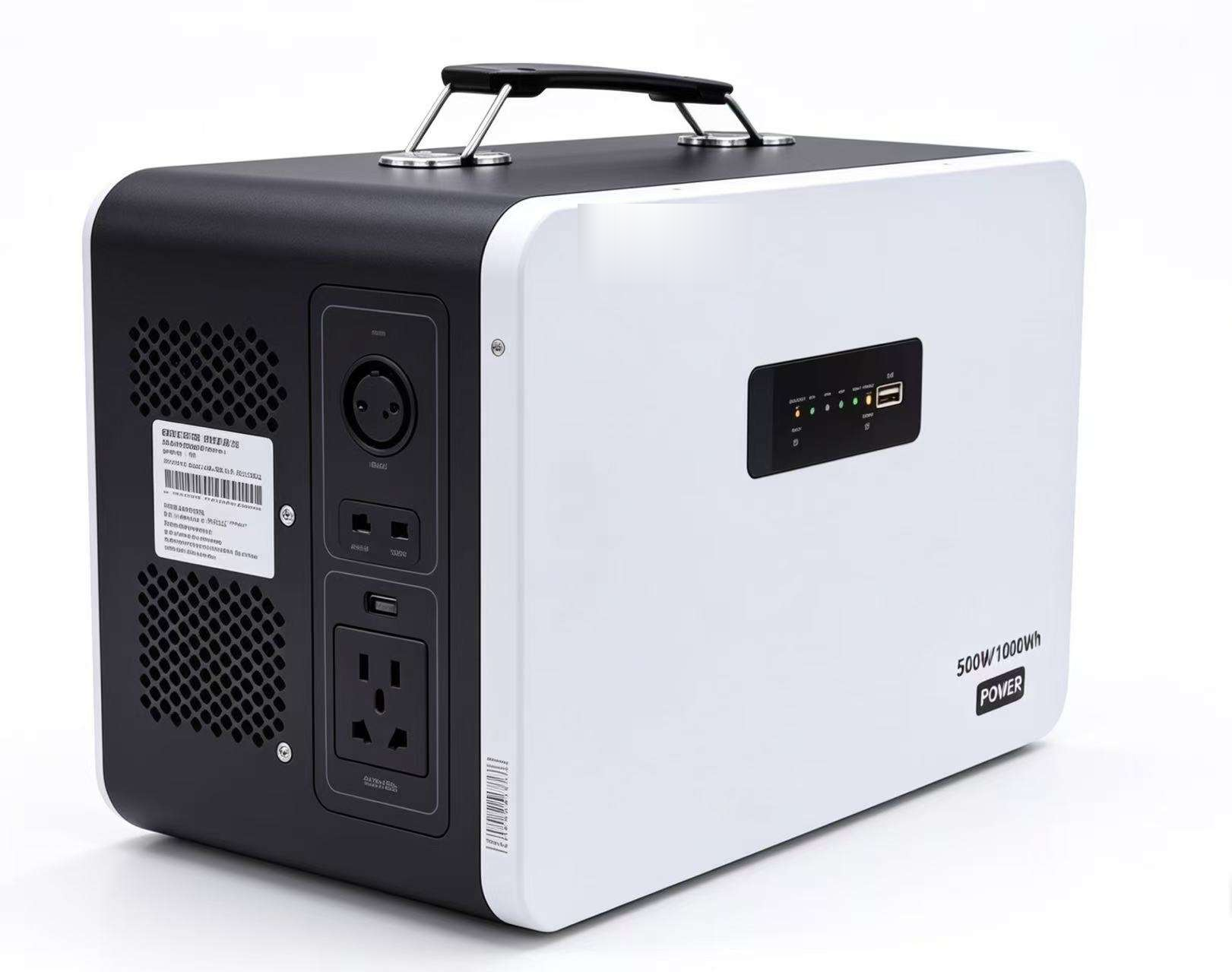
Product video: See the REVO MP product demonstration on YouTube. The video corresponds to the REVO MP model referenced in this section.
The current CVC product material identifies this configuration with a 1,000Wh battery capacity, 500W rated output, LiFePO4 chemistry, pure sine wave output, 230VAC ±5% AC output, 90–280VAC AC input range, 50/60Hz automatic input recognition and a stated 6,000-cycle figure.
Applied to the scenes above, the 267W steady-load example is below 500W on paper, while the approximately 750W pump reference is above it. For the refrigerator, the missing confirmation is peak output versus compressor start-up—not the headline 1,000Wh number.
The same reasoning applies to any other portable power station. Replace the REVO MP figures with the candidate model’s own rated output, peak output, usable capacity, AC waveform, DC port limits and charging specifications.
How to identify the right interface in a product image
The following visual uses the REVO MP image as a recognizable example. It teaches the general reading method: input is where energy enters the station; AC output is for ordinary household plugs; DC and USB outputs are for compatible low-voltage devices.
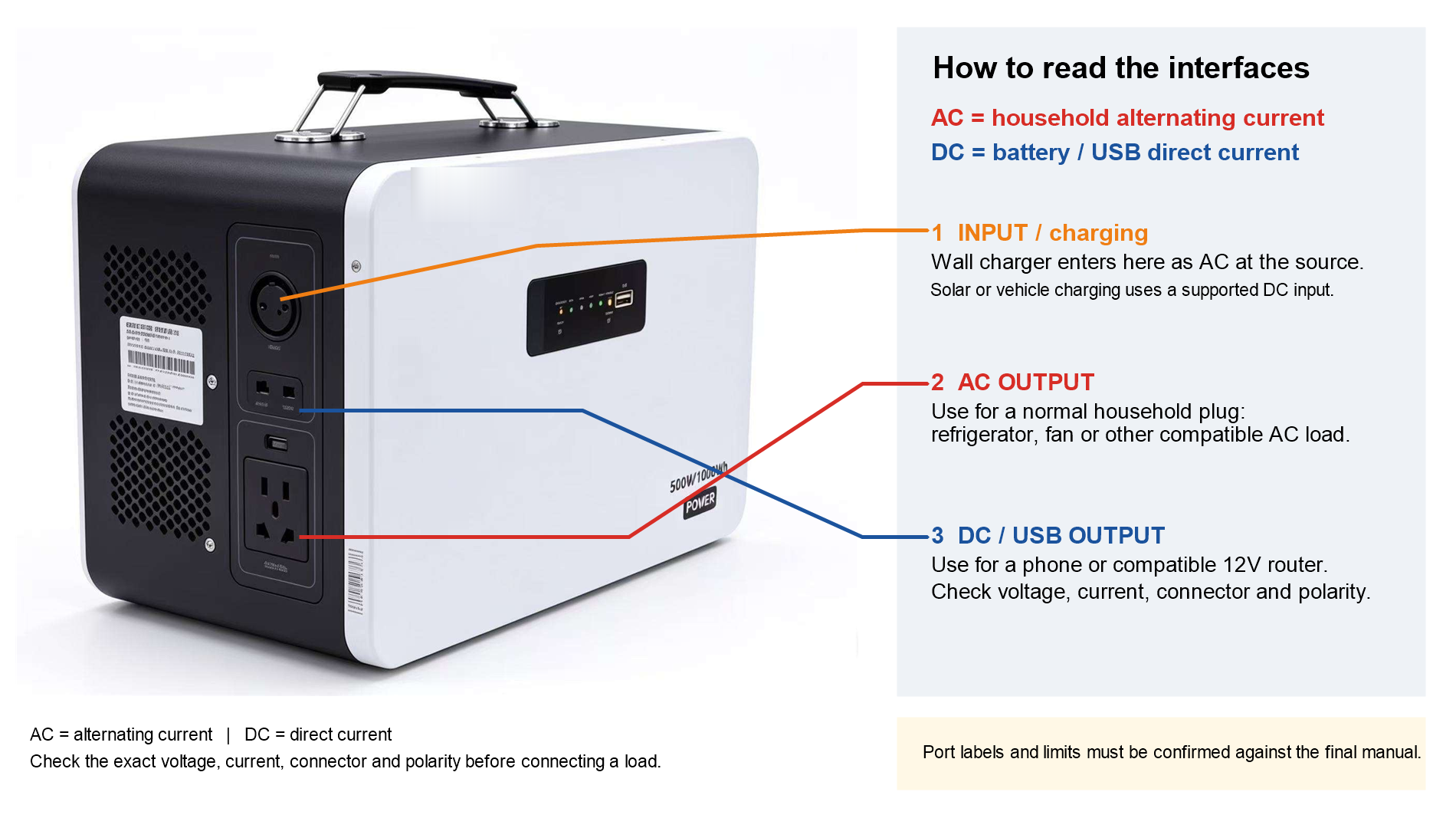
- Find the input area. A wall charger sends energy into the station as AC at the source; the charging module converts it into controlled DC energy for the battery. Solar panels and vehicle charging use supported DC input paths.
- Find the AC output area. This is the household-style socket used by a normal refrigerator or fan plug. The inverter changes battery DC into AC here.
- Find the DC or USB output area. These ports are for devices such as phones, compatible 12V routers or DC refrigerators. Check voltage, current, connector size and polarity.
- Check whether the output stays on. A refrigerator cycles. Some stations use low-current auto-sleep and may shut off between compressor cycles. If supported, continuous-output mode may need to be enabled.
How to choose a portable power station for a real appliance set
Use the appliance list to define the product, rather than starting with a round capacity number.
- List simultaneous loads. Record the model, voltage, rated watts, quantity and the hours each appliance must operate.
- Separate motor loads from electronic loads. Mark compressors, pumps and some fans. These require a peak-output check in addition to the running-watt total.
- Decide AC or DC connection. Use AC for ordinary household plugs. Use direct DC only when voltage, current, connector and polarity are confirmed.
- Check continuous and peak output. The continuous rating must cover the loads that may run together. The peak rating must cover the worst start-up event.
- Calculate usable Wh. Estimate from the actual average load and required hours, then allow for inverter losses, reserve settings and operating conditions.
- Check charging and site conditions. Confirm AC input range, solar input limits, vehicle-charging support, recharge time, plug standard, ambient temperature and pass-through charging.
For a supplier comparison or export quotation, the most useful evidence is the exact appliance model, a nameplate photo, the intended simultaneous-load schedule and the destination-market voltage and plug requirement.
The short version
Correct connection → enough continuous output → enough peak output to start motors → enough usable Wh for the required runtime.
- Refrigerator + fan + router: approximately 267W of listed or adapter-rated load.
- 1HP-class pump: approximately 750W before starting demand.
- All four reference loads: approximately 1,017W before starting demand.
The essential rule is simple: Wh tells you how long, W tells you whether it can run, and peak power tells you whether it can start.

Peter Yin
Send a Project Inquiry
Tell us your country, appliance models, expected simultaneous loads, charging method and estimated quantity.